
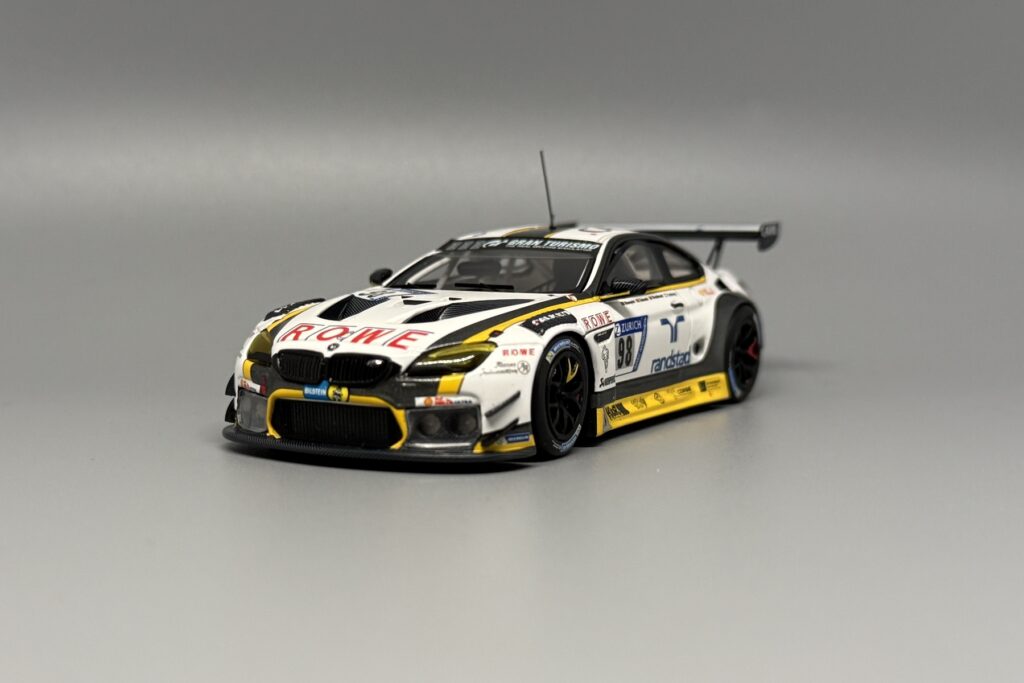
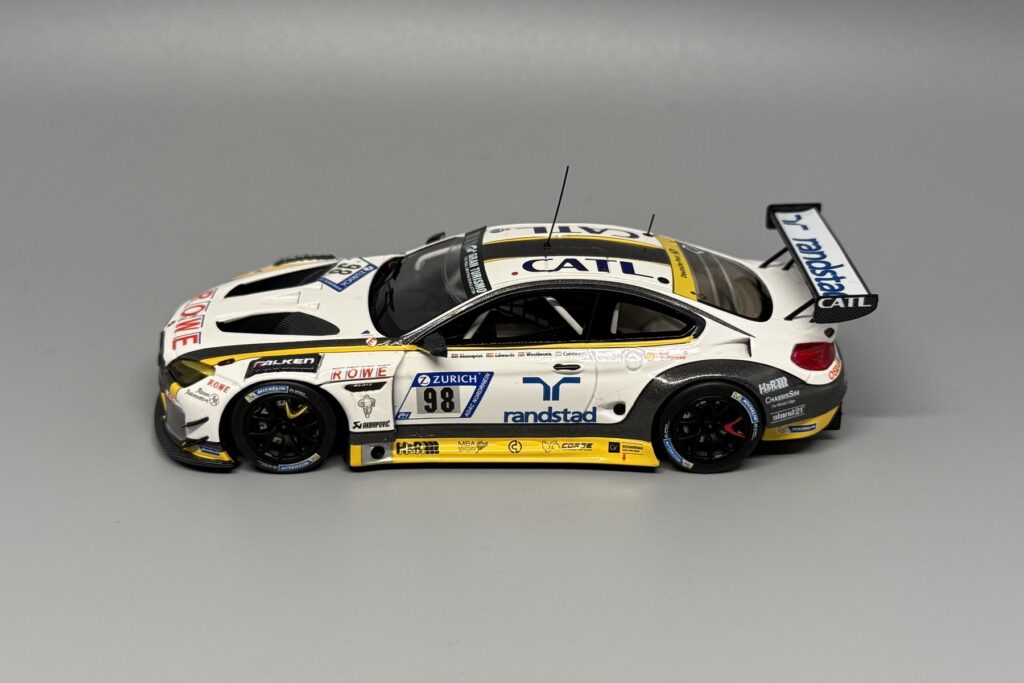
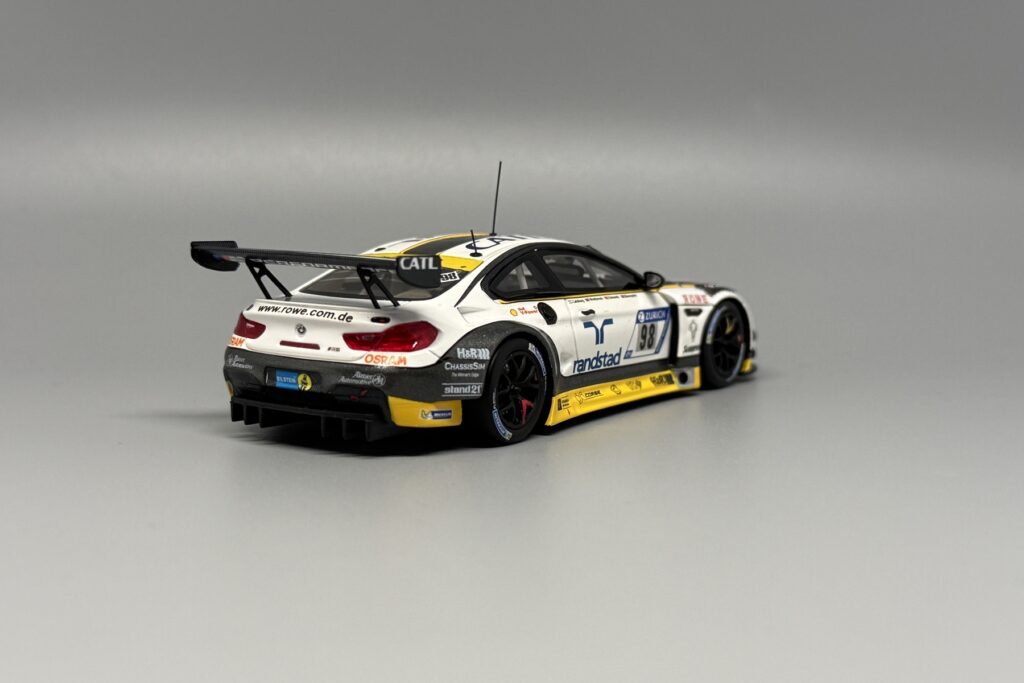
BMW M6 GT3 (F13) was one of BMW’s most important GT racing cars of the 2010s, developed specifically for international GT3 championships and endurance racing. Based on the BMW M6 Coupé, the competition car combined a 4.4-litre twin-turbocharged V8 engine with wide aerodynamic bodywork and a chassis extensively prepared for professional circuit racing. At the 2018 Nürburgring 24 Hours, ROWE Racing entered the BMW M6 GT3 carrying racing number 98, driven by Nicky Catsburg, Richard Westbrook, John Edwards and Tom Blomqvist. The car demonstrated exceptional speed during the opening stages and led the race on several occasions, but a time penalty and subsequent electronic throttle-control failure ended the team’s hopes of victory. The BMW retired after 82 laps. Despite this disappointing result, the number 98 car represents an important period in the history of the BMW M6 GT3, when the model ranked among the leading international GT3 racing machines.
The development of the BMW M6 GT3
The BMW M6 GT3 was developed to replace the successful BMW Z4 GT3, which had reached the later stages of its competitive development. The Z4 had achieved numerous victories in international GT racing, including overall success at the 2015 24 Hours of Spa-Francorchamps. BMW selected the M6 Coupé of the F13 generation as the basis for its successor. The larger body and longer wheelbase offered the potential for improved stability, while the powerful V8 engine provided a new foundation for competition development. BMW Motorsport tested the new GT3 car throughout 2015 before presenting it at the Frankfurt International Motor Show in September. Its racing debut followed in 2016. Unlike some of BMW’s earlier racing projects developed primarily for factory teams, the M6 GT3 was designed as a professional customer racing car. BMW provided its customers with technical support, spare parts and engineering assistance at major international events.
From the BMW M6 Coupé to a racing car
The BMW M6 GT3 was derived from the F13-generation BMW M6 Coupé, although its competition engineering differed substantially from the road-going model. The long bonnet, low roofline and recognisable two-door coupé silhouette were retained, but the car received greatly widened wheel arches, enlarged air intakes, a deep front splitter and a prominent rear wing. Development focused on aerodynamic efficiency, structural rigidity and ease of maintenance during endurance racing. BMW engineers used wind-tunnel testing to achieve an effective balance between low aerodynamic drag and the downforce required for high-speed cornering. This was especially important in endurance competition, where the car needed to perform consistently on both long straights and technically demanding sections. The E63 designation belonged to the preceding generation of the BMW 6 Series, while the M6 Coupé on which the GT3 racer was based carried the F13 body code.
The 4.4-litre twin-turbocharged V8
The BMW M6 GT3 was powered by a 4,395 cc twin-turbocharged V8 engine derived from the S63 engine family used in the production BMW M6. Compared with the naturally aspirated V8 of its Z4 GT3 predecessor, the new power unit offered greater torque and a different performance character. BMW Motorsport adapted the engine for professional racing, including a specially developed dry-sump-based lubrication system designed to maintain oil supply under high cornering forces. According to BMW’s official specifications, the engine could produce up to 585 hp, although its permitted output depended on the Balance of Performance regulations applied to each championship. These regulations controlled factors such as engine performance and vehicle weight to keep different GT3 models competitively balanced. Consequently, the published maximum of 585 hp should not automatically be regarded as the exact power output of ROWE Racing’s number 98 car at the 2018 Nürburgring 24 Hours.
Transaxle transmission and racing suspension
The BMW M6 GT3 featured a six-speed sequential racing transmission mounted towards the rear of the car in a transaxle layout. This arrangement helped distribute weight between the axles and allowed the drivetrain to be positioned low in the chassis. Power was transmitted to the rear wheels through a mechanical limited-slip differential. Independent double-wishbone suspension was fitted at both ends, incorporating adjustable anti-roll bars and multi-adjustable racing dampers. The braking system used six-piston calipers at the front and four-piston calipers at the rear. Competition ABS and traction control were also provided, offering important assistance under changing track and weather conditions. According to BMW’s factory documentation, the M6 GT3 weighed less than 1,300 kg without the driver. Compared with the large production M6 Coupé, it was an exceptionally lightweight racing machine whose engineering was focused on achieving consistently fast lap times.
Safety and endurance racing requirements
BMW Motorsport paid particular attention to driver protection and mechanical reliability when developing the M6 GT3. The racing car retained a reinforced steel body structure incorporating a welded FIA-compliant safety cage. Carbon-fibre-reinforced crash structures were fitted at the front and rear to improve impact protection. The driver’s seat was positioned closer to the vehicle’s centreline to provide additional protection in side impacts. The cockpit was also designed to make driver changes and emergency assistance easier during long races. BMW developed a dedicated racing seat, while a roof opening allowed a driver’s helmet to be removed more safely if necessary following an accident. Ease of access to mechanical components and the durability of parts subject to regular replacement were equally important considerations. BMW’s objective was to create a competition car combining high performance with reliability, manageable operating costs and practical support for professional customer racing teams.
ROWE Racing and its partnership with BMW
ROWE Racing is a German endurance racing team closely associated with the Nürburgring and international GT competitions. The team operates within the Motorsport Competence Group and has long been managed by Hans-Peter Naundorf. Following earlier competition with Mercedes-Benz GT cars, ROWE Racing switched to the BMW M6 GT3 for the 2016 season. The partnership delivered immediate success when Maxime Martin, Philipp Eng and Alexander Sims won the 24 Hours of Spa-Francorchamps in a ROWE Racing BMW in July that year. In 2017, the team achieved second place overall at the Nürburgring 24 Hours with its number 98 BMW M6 GT3. ROWE Racing consequently became one of BMW’s most important endurance racing partners. The team arrived at the 2018 Nürburgring race with considerable expectations, having already demonstrated that the M6 GT3 possessed both the speed and endurance potential required to challenge for overall victory.
The 2018 Nürburgring 24 Hours
The 46th Nürburgring 24 Hours took place on 12–13 May 2018, using the combined Nordschleife and Grand Prix circuit measuring 25.378 kilometres. The Nürburgring is among the world’s most demanding racing venues, featuring long high-speed sections, narrow corners, major elevation changes and rapidly varying weather conditions. GT3 cars competed in the SP9 category, where professional teams representing BMW, Porsche, Audi, Mercedes-AMG and other manufacturers challenged for overall honours. The 2018 event was characterised by numerous incidents and unpredictable weather. Racing was suspended for approximately two hours during the closing stages because of poor conditions, while overall victory eventually went to the Manthey Racing Porsche 911 GT3 R carrying number 912. BMW experienced a difficult race, with several of its fastest M6 GT3 entries retiring because of mechanical problems or incidents.
Car number 98 – four experienced drivers
ROWE Racing’s BMW M6 GT3 carrying number 98 was shared at the 2018 Nürburgring 24 Hours by Nicky Catsburg, Richard Westbrook, John Edwards and Tom Blomqvist. The team brought together four highly experienced international competitors. Dutch driver Catsburg had established a strong reputation in GT and touring car racing and possessed extensive experience of the Nürburgring. Britain’s Westbrook had enjoyed success in GT and prototype endurance racing and had been part of ROWE Racing’s second-place Nürburgring crew in 2017. American driver Edwards was closely associated with BMW’s international GT racing programmes, including endurance events in North America. Blomqvist had previously competed in the BMW M4 DTM before increasingly concentrating on GT and endurance racing. This combination of experience gave ROWE Racing a driver line-up capable of challenging at the front in both dry and changing conditions.
Leading during the opening stages
BMW M6 GT3 number 98 made an exceptionally strong start to the 2018 Nürburgring race. According to BMW’s official post-race report, the ROWE Racing car shared by Catsburg, Westbrook, Edwards and Blomqvist took the lead on several occasions during the opening stages. Its pace was sufficient to challenge the leading Porsche, Audi and Mercedes-AMG teams. At the end of the third hour, the BMW was running second overall, only a few seconds behind the leader. It remained in contention during the seventh hour, but the team then suffered a significant setback. A yellow-flag infringement resulted in a 3-minute and 32-second time penalty for car number 98. The penalty was served during a subsequent pit stop and dropped the BMW behind the leading group. Although the car continued racing, the lost time made the battle for overall victory considerably more difficult.
Technical failure and retirement
The time penalty was followed by a more serious problem during the night, bringing an end to ROWE Racing’s challenge with car number 98. According to BMW’s official explanation, the car developed problems with its electronic drive-by-wire throttle-control system. In contrast to a conventional mechanical throttle cable, this system uses electronic signals to interpret the accelerator pedal position and control the engine’s throttle response. The fault affected the car sufficiently to prevent the team from continuing. Racing records show that BMW number 98 completed 82 laps, equivalent to approximately 2,081 kilometres. Its fastest race lap was recorded at 8 minutes and 20.485 seconds. Although the official result was a retirement, the opening half of the race demonstrated that the ROWE Racing BMW M6 GT3 possessed the performance required to compete for overall victory at the Nürburgring 24 Hours.
BMW M6 GT3 success in endurance racing
The racing history of the BMW M6 GT3 extended far beyond its 2018 Nürburgring appearance. During its first competitive season in 2016, the model achieved overall victory at the 24 Hours of Spa-Francorchamps with ROWE Racing. Another Spa victory followed in July 2018, this time with the number 34 BMW M6 GT3 entered by Walkenhorst Motorsport and driven by Philipp Eng, Tom Blomqvist and Christian Krognes. This result was especially impressive because Walkenhorst defeated several highly experienced factory-supported GT3 teams. Development of the M6 GT3 continued over subsequent seasons. In 2020, ROWE Racing secured overall victory at the Nürburgring 24 Hours with a BMW M6 GT3 carrying number 99, driven by Nicky Catsburg, Alexander Sims and Nick Yelloly. These achievements confirmed that BMW’s large GT3 coupé remained competitive over several consecutive years.
The legacy of the BMW M6 GT3
The BMW M6 GT3 served as BMW Motorsport’s principal international GT3 racing model from 2016 to 2021, before being succeeded by the BMW M4 GT3. Compared with the Z4 GT3, the M6 featured a larger body, longer wheelbase and twin-turbocharged V8 engine, becoming a successful competitor on circuits across Europe and other continents. Its victories at Spa-Francorchamps and the Nürburgring demonstrated that a racing car developed from a large coupé could excel in some of the world’s most demanding endurance events. The story of ROWE Racing’s number 98 car in 2018 also illustrates the unpredictable nature of motorsport: exceptional speed and periods in the lead do not guarantee success if the car cannot remain mechanically reliable until the finish. This combination of sophisticated engineering, intense competition and dramatic racing history gives the BMW M6 GT3 an important place in the marque’s modern motorsport heritage.
Model in the collection
The BMW M6 GT3 (F13) model in my collection was produced by Minichamps. It represents the ROWE Racing BMW carrying number 98 at the 2018 Nürburgring 24 Hours, driven by Nicky Catsburg, Richard Westbrook, John Edwards and Tom Blomqvist. The original car led the race on several occasions during the opening stages but later retired because of an electronic throttle-control failure. The model reproduces the M6 GT3’s wide competition bodywork, characteristic aerodynamic details, prominent rear wing, historic racing numbers and authentic sponsorship markings. It was released as a limited edition of 200 pieces.
Technical data
Racing model unveiled: 2015
Competition debut: 2016
Represented racing year: 2018
Base vehicle: BMW M6 Coupé (F13)
Body style: two-door enclosed GT racing coupé
Competition category: FIA GT3 / Nürburgring SP9
Developer: BMW Motorsport, Germany
Engine: twin-turbocharged V8 derived from the BMW S63 engine family
Displacement: 4,395 cc
Power output: up to 585 hp, depending on Balance of Performance regulations
Lubrication: dry-sump-based system developed by BMW Motorsport
Engine position: longitudinal front engine
Transmission: 6-speed sequential transaxle racing gearbox
Drive: rear-wheel drive
Differential: mechanical limited-slip differential
Chassis: reinforced steel body with welded roll cage and carbon-fibre-reinforced crash structures
Suspension: independent double-wishbone suspension at both ends
Dampers: multi-adjustable competition dampers
Brakes: six-piston front and four-piston rear racing calipers
Driver aids: racing ABS and traction control
Weight: less than 1,300 kg without driver according to BMW specifications, depending on regulations
Length: 4,944 mm
Width: 2,046 mm
Tyres: racing tyres; BMW type specification 310/710 × 18
Wheels: 13 × 18 inches
Fuel tank: up to 125 litres according to BMW competition documentation, depending on regulations
Race: Nürburgring 24 Hours, 12–13 May 2018
Circuit length: 25.378 km
Team: ROWE Racing
Racing number: 98
Drivers: Nicky Catsburg, Richard Westbrook, John Edwards and Tom Blomqvist
Laps completed: 82
Distance covered: approximately 2,081 km
Fastest race lap: 8 min 20.485 sec
Result: retired
Reason for retirement: electronic drive-by-wire throttle-control problems
Race highlight: the car led several times during the opening stages before losing time through a penalty and a technical failure
Competition cars produced: exact overall production total unconfirmed
Special feature: ROWE Racing BMW M6 GT3 that challenged for the lead during the opening half of the 2018 Nürburgring 24 Hours before retiring after 82 laps