
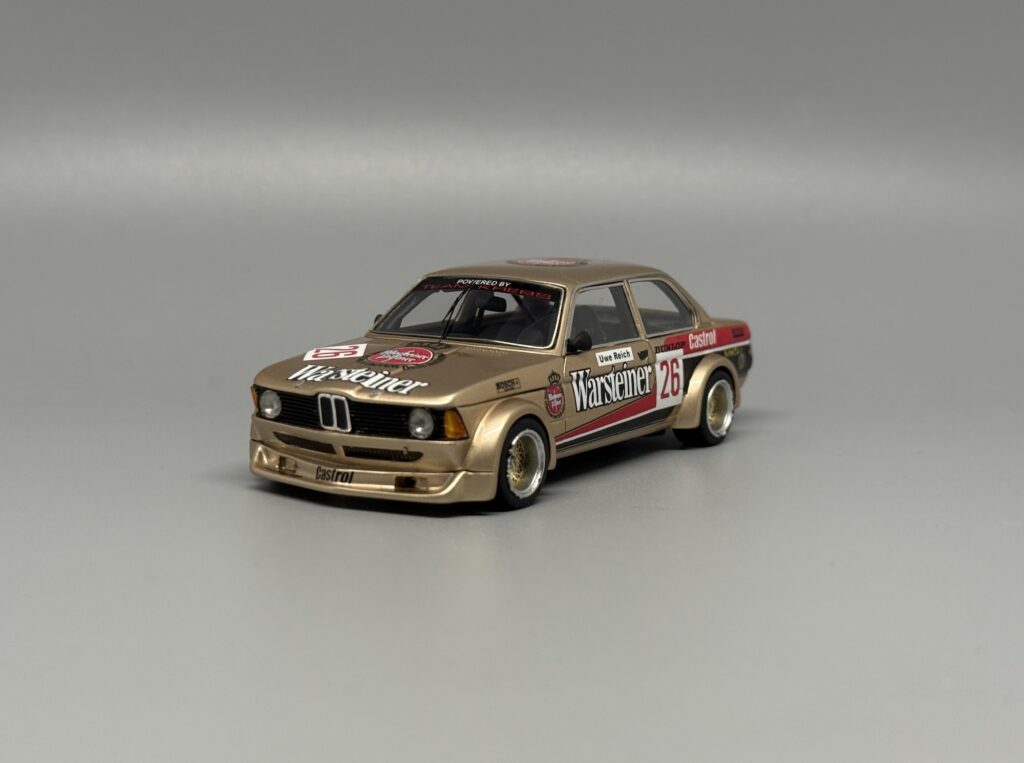
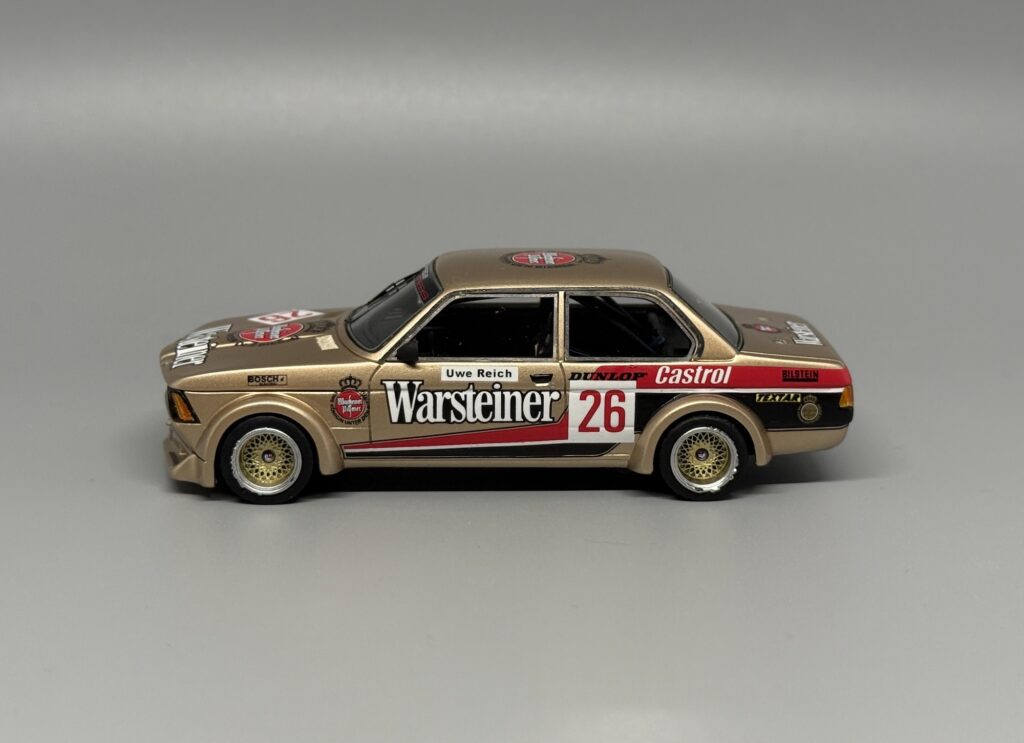
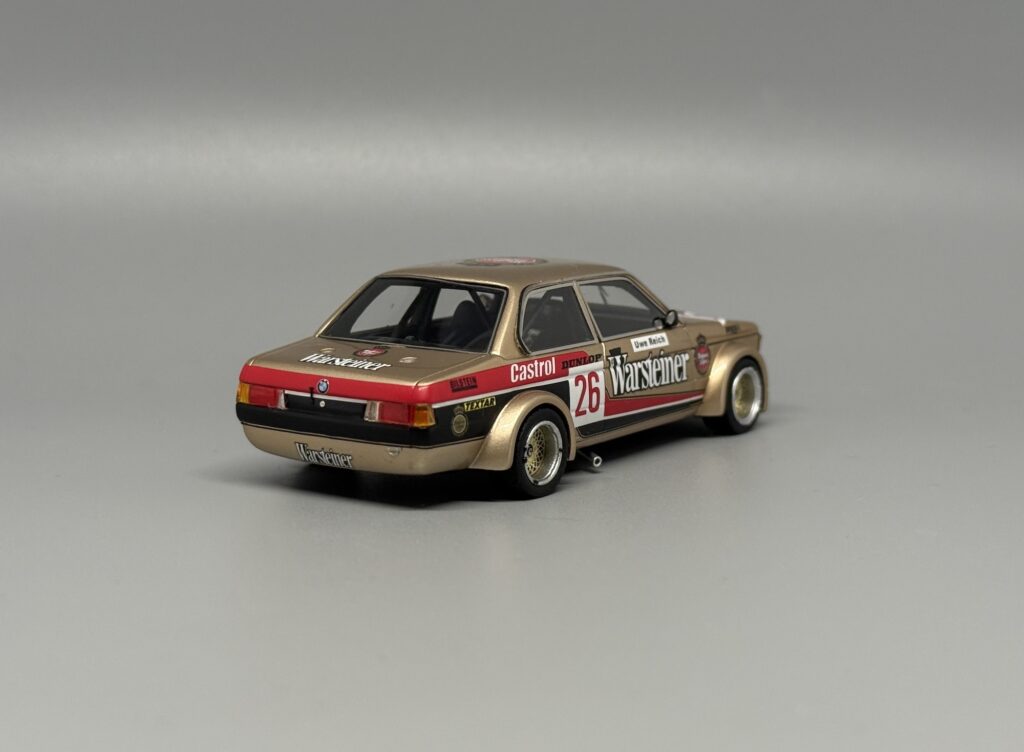
BMW 320i Gr.2 Warsteiner DRM 1979 (E21) represents the racing history of the first-generation BMW 3 Series and an era when production-based touring cars competed alongside radical silhouette racing machines on German circuits. In 1979, Team Warsteiner-TBS fielded a BMW 320 in the distinctive gold Warsteiner racing livery, driven by German competitor Uwe Reich. Carrying racing number 26, the car was entered for the opening round of the DRM season at Zolder in Belgium on 11 March 1979, although it did not start the race. Unlike the powerful Group 5 BMW 320 competition cars of the same period, Reich’s BMW used a naturally aspirated two-litre four-cylinder engine and was entered in the Deutsche Automobil-Rennsport-Trophäe classification. It therefore represents an interesting example of the many different ways in which the E21 generation was used in late-1970s motorsport.
The BMW E21 enters motor racing
The first-generation BMW 3 Series (E21) was introduced in 1975 as the successor to the successful BMW 02 Series. It continued BMW’s tradition of compact and sporting rear-wheel-drive cars, combining a driver-focused interior, balanced chassis and precise handling. The original E21 range featured four-cylinder engines, with the BMW 320i among its most sporting variants. In its original production specification, the 320i developed 125 hp, making it one of BMW’s most powerful compact saloons of the mid-1970s. By this time, BMW had already established a strong reputation in touring-car racing through the successes of the BMW 2002 and 3.0 CSL. The arrival of the E21 provided an opportunity to apply this experience to a new generation of cars. Alongside BMW Motorsport’s factory projects, independent teams began developing competition versions of the E21 for German and European circuit racing.
Deutsche Rennsport Meisterschaft
The Deutsche Rennsport Meisterschaft, commonly known as the DRM, was one of Germany’s most important circuit racing championships during the 1970s and 1980s. By 1979, its fastest competitors had evolved into Group 5 silhouette racers, which retained the recognisable appearance of production cars but differed enormously in engineering, aerodynamics and engine performance. Racing was divided into two divisions, with Division I covering cars above two litres and Division II those with engines of up to two litres. The same racing weekends also featured the Deutsche Automobil-Rennsport-Trophäe, a competition for Group 2 touring cars and Group 4 GT machinery. Consequently, the starting fields could include extremely powerful turbocharged BMWs alongside more production-based cars equipped with naturally aspirated engines. This technical diversity was one of the defining characteristics of German motor racing during the DRM era.
Team Warsteiner-TBS
Major commercial sponsors became increasingly important in German circuit racing during the 1970s, with distinctive racing liveries helping teams establish a recognisable public identity. Warsteiner was among the most prominent sponsors associated with BMW competition cars. At the beginning of the 1979 season, Team Warsteiner-TBS operated BMW 320 racing cars with different technical specifications. Its more advanced competition programme included a turbocharged Group 5 BMW 320 driven by Albrecht Krebs. Uwe Reich’s BMW, carrying number 26, was a more production-based competition car entered in the Rennsport-Trophäe classification. The presence of these different machines within the same team illustrates the variety of BMW E21 racing applications. Reich’s car stood out through its gold Warsteiner livery, contrasting dark details and widened competition bodywork.
11 March 1979 – the Bergischer Löwe at Zolder
The 1979 DRM season opened on 11 March at the Zolder circuit in Belgium, with the event known as the Bergischer Löwe. The 4.284-kilometre circuit was a regular venue for German racing championships during the period. The entry included Porsche 935s, Ford Capri Turbo racing cars and numerous versions of the BMW 320. Team Warsteiner-TBS entered Uwe Reich’s BMW 320, carrying racing number 26, in Division II of the Rennsport-Trophäe for cars with engines of up to two litres. A surviving period photograph in the Racing Sports Cars archive confirms the car’s presence at the event and documents its distinctive Warsteiner appearance. However, the official results record the BMW as a non-starter. It therefore cannot be credited with a finishing position or a race retirement, and the precise reason for its failure to start is not stated in the available competition records.
Group 2 and the Rennsport-Trophäe
The Neo Scale Models miniature identifies the car as a BMW 320i Gr.2, referring to the FIA Group 2 regulations for special touring cars. These rules permitted production-based competition vehicles to use modified engines, upgraded suspension, widened wheel arches and specialised racing safety equipment. Compared with the more extreme Group 5 silhouette machines, Group 2 cars retained a much closer technical relationship with their production counterparts. For Uwe Reich’s BMW, however, the exact classification in the Zolder race records deserves particular attention. The entry list identifies the car with the abbreviation RT, referring to the Deutsche Automobil-Rennsport-Trophäe category, which included both Group 2 touring cars and Group 4 GT vehicles. The Group 2 description used by the model manufacturer is therefore consistent with the type of competition car represented, while its documented classification at Zolder was RT Division II.
The naturally aspirated two-litre four-cylinder
Uwe Reich’s BMW differed significantly from the Group 5 cars developed by BMW Motorsport and other specialist teams, which frequently employed sophisticated four-valve or turbocharged engines. According to the Zolder racing archive, Reich’s car used a 1,990 cc BMW M10 four-cylinder inline engine. The naturally aspirated unit featured a single overhead camshaft and two valves per cylinder. The BMW M10 was among the manufacturer’s most versatile engines of the 1960s and 1970s and provided the basis for several successful racing developments. In standard production form, the early BMW 320i developed 125 hp, but competition engines were frequently modified to produce substantially higher outputs. The exact power, fuel-delivery system and gearbox specification of Reich’s Warsteiner BMW have not been conclusively documented. Consequently, neither the standard 125 hp figure nor the much higher outputs of other E21 racing versions can be reliably attributed to this particular car.
Competition-prepared bodywork and chassis
The Warsteiner BMW 320 retained the recognisable two-door body shape of the E21 generation but was extensively adapted for circuit racing. Widened wheel arches allowed the installation of broader racing tyres, while a lower ride height helped reduce the centre of gravity. Aerodynamic additions were intended to improve stability at higher speeds. Period photographs from Zolder also show distinctive racing wheels and the car’s competition bodywork. The production BMW E21 featured independent front suspension and semi-trailing-arm rear suspension, but racing applications required modifications to accommodate greater cornering loads and improved tyre grip. The competition archive confirms that Uwe Reich’s car used Dunlop tyres. However, precise figures for its racing weight, suspension settings and braking system have not been sufficiently documented to be presented as confirmed specifications of this particular vehicle.
Different racing versions of the BMW 320
Several very different development paths must be distinguished when examining the racing history of the E21 generation. The best-known machines were BMW Motorsport’s Group 5 cars, driven by competitors including Hans-Joachim Stuck, Ronnie Peterson and the young drivers of the BMW Junior Team. These cars featured highly specialised racing technology and ranked among the fastest two-litre touring-based competition machines of their era. Later turbocharged versions achieved even greater power outputs and competed in major international championships. At the same time, independent teams developed E21-based racing cars for Group 2 and other touring-car categories, retaining a closer relationship with the original production design. Uwe Reich’s Warsteiner BMW belonged to this latter tradition. Its historical importance lies in representing a less celebrated but significant aspect of E21 motorsport: the contribution made by independent teams competing in national racing events.
The significance of the Warsteiner BMW 320i
The BMW 320i Gr.2 Warsteiner DRM 1979 illustrates how cars based on the same production generation could compete in very different categories of German motor racing during the late 1970s. Although Uwe Reich did not start the 1979 Zolder race and no finishing result can be attributed to this particular entry, its identity is preserved in the contemporary entry records and a period photograph. Its Warsteiner livery, naturally aspirated M10 engine and association with Team Warsteiner-TBS give the car a clear historical background. It represents the part of BMW E21 racing history in which independent preparation specialists, engineering ingenuity and smaller competition programmes played an important role alongside major factory-supported teams. The Warsteiner BMW 320 therefore adds another dimension to the motorsport heritage of the first BMW 3 Series beyond the much more famous Group 5 racing cars.
Model in the collection
The BMW 320i Gr.2 Warsteiner DRM 1979 (E21) model in my collection was produced by Neo Scale Models. It is an exclusive edition produced for Model Car World, representing Uwe Reich’s 1979 Team Warsteiner-TBS BMW carrying racing number 26. The model reproduces the E21 racing car’s widened bodywork, low stance, distinctive competition wheels and historic Warsteiner livery. It was released as a limited edition of 500 pieces.
Technical data
Competition year: 1979
Base vehicle: BMW 320 (E21)
Body style: two-door enclosed touring racing car
Racing series: Deutsche Automobil-Rennsport-Trophäe, held during DRM race weekends
Competition classification: RT, Division II (up to 2,000 cc)
Racing car category: Group 2-type touring car
Vehicle origin: BMW, Germany
Team: Team Warsteiner-TBS
Driver: Uwe Reich, Germany
Engine: BMW M10 naturally aspirated inline-four
Displacement: 1,990 cc
Valve gear: single overhead camshaft, two valves per cylinder
Competition engine output: exact figure unconfirmed
Engine position: longitudinal front engine
Drive: rear-wheel drive
Bodywork: competition-modified BMW E21 body with widened wheel arches
Suspension: independent front suspension and semi-trailing-arm rear suspension, modified for racing
Tyres: Dunlop
Documented event: DRM Zolder Bergischer Löwe, Belgium, 11 March 1979
Circuit: Zolder, 4.284 km
Racing number: 26
Race result: did not start (DNS)
Reason for non-start: unconfirmed
Competition cars produced: exact number unconfirmed
Special feature: Team Warsteiner-TBS BMW 320 with a naturally aspirated two-litre M10 engine, entered in the Rennsport-Trophäe Division II at the opening 1979 DRM race weekend at Zolder