
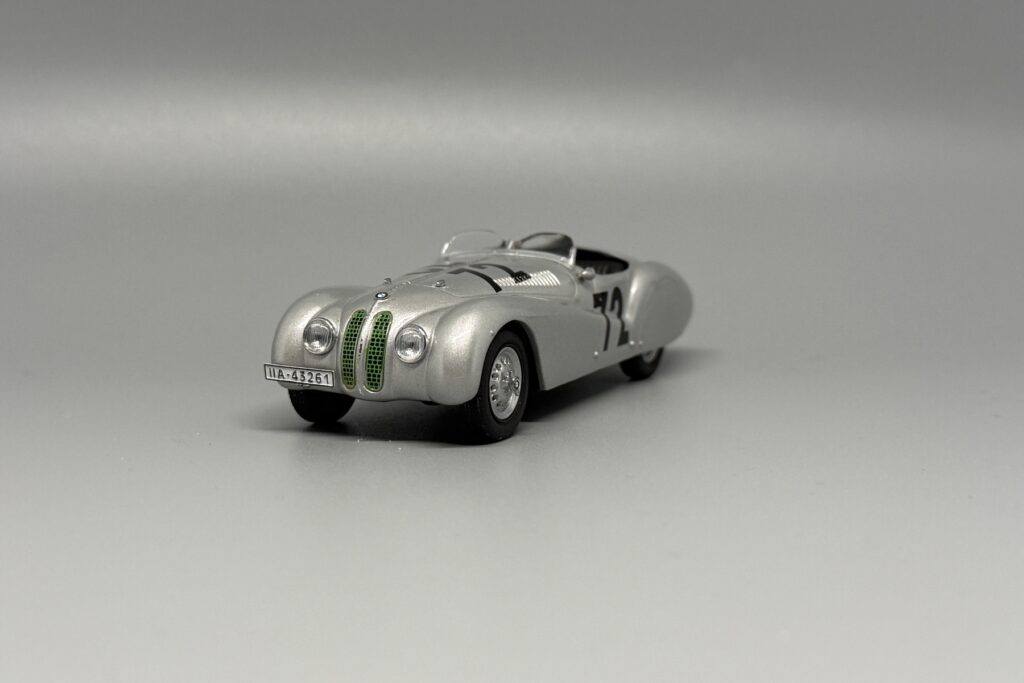
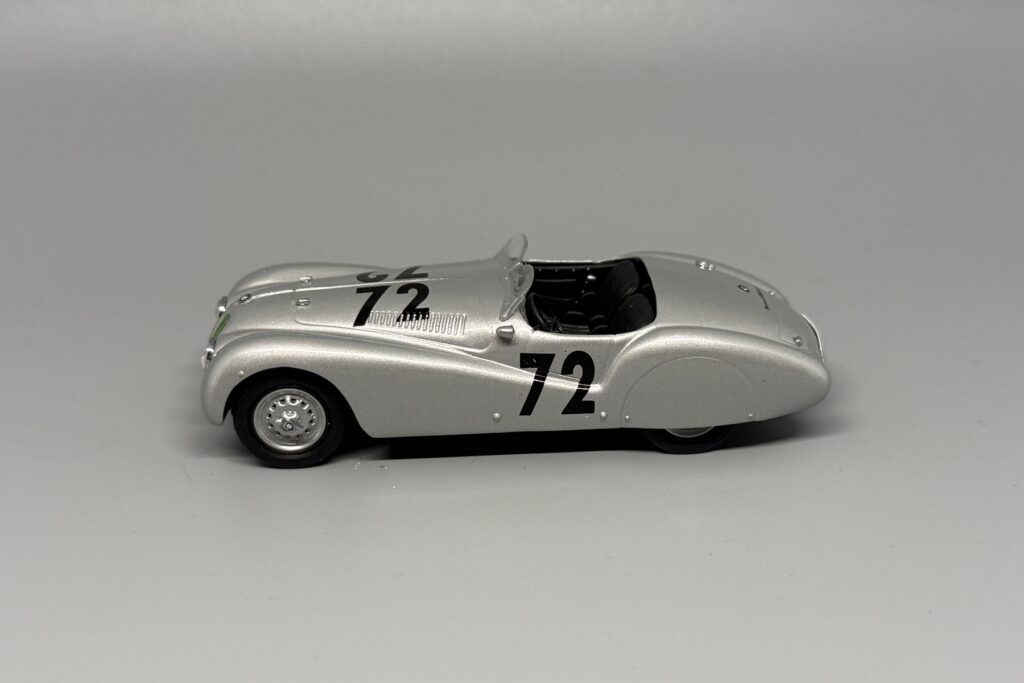
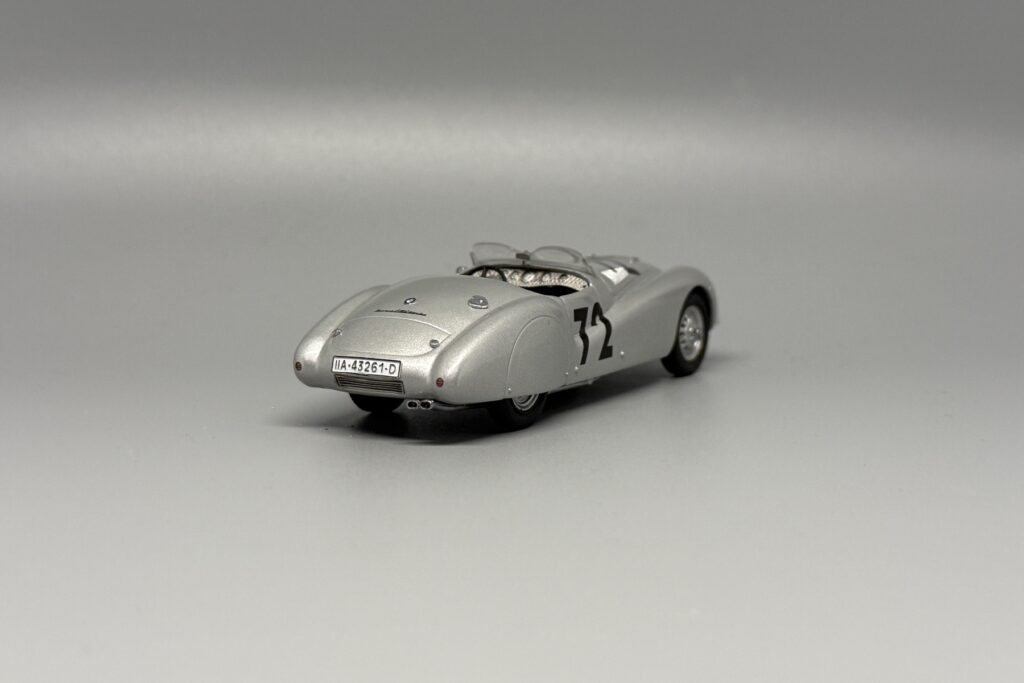
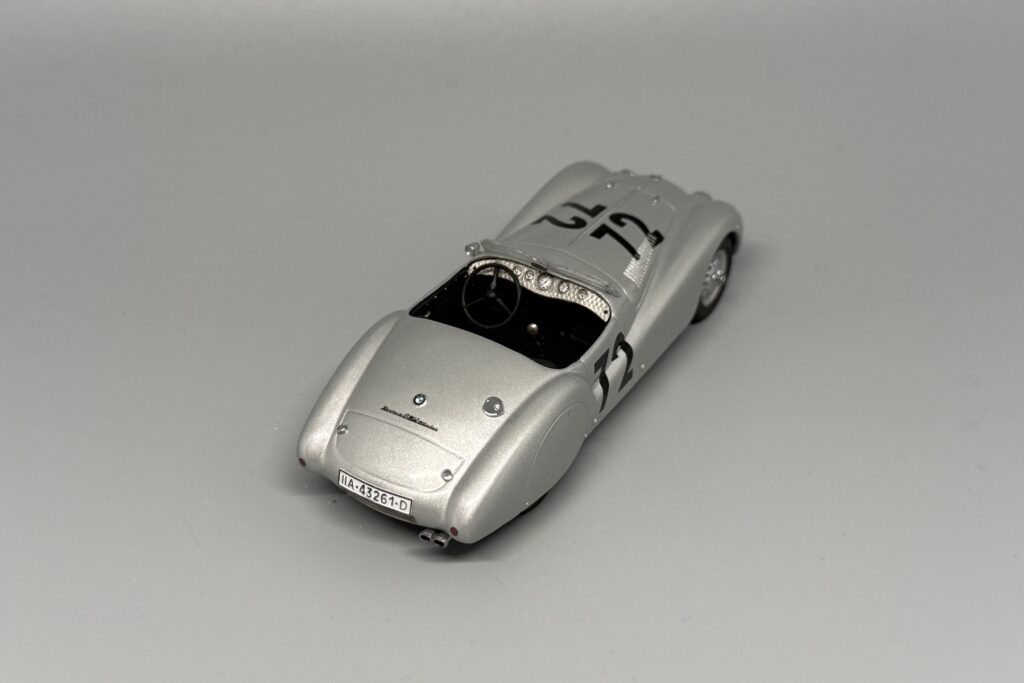
BMW 328 Roadster Mille Miglia #72 was one of three streamlined BMW 328 Roadsters specially prepared for the 1940 Mille Miglia. Driven by Willi Briem and Uli Richter, car number 72 finished fifth overall and helped BMW secure victory in the team classification. Unlike the standard BMW 328 Roadster, this competition car featured an exceptionally lightweight and aerodynamic aluminium body built by Carrozzeria Touring in Milan, designed to reduce drag and improve stability at high speeds. With a 130 hp six-cylinder engine, a weight of just 700 kilograms and a top speed of 200 km/h, it represented one of the most remarkable racing cars in BMW’s pre-war motorsport history.
The culmination of BMW 328 racing development
Since its racing debut at the Nürburgring in 1936, the BMW 328 had established itself as one of Europe’s most successful two-litre sports cars. Its principal strengths were low weight, excellent handling and a reliable six-cylinder engine. Victory in its class at the 1938 Mille Miglia and another two-litre class victory at the 1939 24 Hours of Le Mans demonstrated the effectiveness of BMW’s engineering philosophy. However, competition was becoming increasingly demanding, and further increases in engine power alone were no longer sufficient. BMW engineers began to concentrate on aerodynamic efficiency, recognising that a more streamlined body could achieve considerably higher speeds without requiring a larger engine. This development programme resulted in several special BMW 328 racing cars during 1939 and 1940, including the Touring Coupé, Kamm-Coupé and three streamlined Mille Miglia Roadsters.
Coachwork by Carrozzeria Touring
Three new streamlined BMW 328 Roadsters were planned for the 1940 Mille Miglia. Their aerodynamic design was developed by BMW’s engineering department under the direction of Wilhelm Meyerhuber and tested in a wind tunnel. The first car was completed in BMW’s own Munich workshops and later became known as the Bügelfalte Roadster because of its distinctive creases along the wings. However, BMW lacked sufficient time and production capacity to finish the remaining two cars before the race. Their partially completed structures were therefore sent to the Milanese coachbuilder Carrozzeria Touring, where Italian craftsmen completed the bodies according to BMW’s designs. Lightweight tubular frameworks were covered with thin aluminium panels, producing exceptionally light and streamlined coachwork. One of these two Touring-bodied cars was the Roadster that subsequently competed with racing number 72.
A streamlined and exceptionally light Roadster
The appearance of the BMW 328 Mille Miglia Roadster differed substantially from that of the standard production model. Its front end was longer and lower, with the headlights integrated into streamlined wings and smooth body surfaces designed to minimise air resistance. The broad wings flowed into the low central body, aerodynamic wheel discs reduced turbulence around the wheels, and a small racing windscreen helped maintain efficient airflow. The rear bodywork was similarly low and carefully shaped to allow air to separate smoothly from the car. Thin aluminium panels and the removal of unnecessary equipment contributed to considerable weight savings. According to official BMW figures, the Mille Miglia Roadster weighed just 700 kg, approximately 80 kg less than the standard BMW 328 Roadster. Together with its improved aerodynamics, the reduced weight provided a substantial performance advantage.
The 130 hp two-litre straight-six
The Roadster carrying number 72 was powered by an enhanced version of the BMW 328’s naturally aspirated 1,971 cc inline-six engine. While the standard production car developed 80 hp, the specialised competition engine produced 130 hp at 5,750 rpm according to BMW Classic. The engine featured an aluminium-alloy cylinder head, inclined valves and a sophisticated valve-operating system driven by a camshaft located in the engine block. Its specific output was exceptional for the period, particularly as the engine achieved this performance without supercharging. Power was transmitted to the rear wheels through a four-speed manual gearbox. The car was capable of reaching 200 km/h, an impressive figure for an open sports car equipped with a naturally aspirated engine of only two litres.
Engineering for endurance racing
The competition preparation of the BMW 328 Mille Miglia Roadster extended far beyond its more powerful engine and lightweight body. The car retained the basic engineering principles of the BMW 328, including its tubular chassis, independent front suspension and rigid rear axle, but its components were adapted for sustained high-speed competition. The braking system featured special Alfin drum brakes with ventilated backing plates, helping to control heat during demanding use. Particular attention was also paid to engine reliability, cooling and fuel delivery. The long-distance nature of the Mille Miglia required a car capable of maintaining high average speeds for many hours without overloading its mechanical components. Consequently, the development of the BMW 328 racing cars focused on achieving a careful balance between performance, low weight and durability.
The unusual 1940 Mille Miglia
The race held on 28 April 1940 was officially known as the I Gran Premio Brescia delle Mille Miglia. Unlike the traditional event, which followed an approximately 1,600-kilometre route from Brescia to Rome and back, the 1940 competition used a 167-kilometre circuit connecting Brescia, Cremona and Mantua. The competitors completed nine laps, covering a total distance of 1,503 kilometres. The revised course was relatively flat, with good road surfaces and numerous long straights, allowing exceptionally high average speeds. The event took place after the outbreak of the Second World War and was the last Mille Miglia before racing resumed in 1947. For BMW, it represented an exceptionally important opportunity to demonstrate the capabilities of its latest racing technology, and five specially prepared BMW 328 competition cars were entered.
Car number 72 – Willi Briem and Uli Richter
BMW entered two coupés and three streamlined Roadsters in the 1940 Mille Miglia. Car number 72 was driven by Wilhelm, known as Willi, Briem and Ulrich, known as Uli, Richter. The other Roadsters carried racing numbers 71 and 74, while the Touring Coupé competed as number 70 and the Kamm-Coupé as number 73. BMW racing director Ernst Loof had developed a carefully planned strategy for the event. The two coupés were expected to challenge for overall victory, while the Roadsters were instructed to maintain competitive speeds without placing unnecessary strain on their mechanical components. Their primary objective was to finish reliably and help secure the team prize. Briem and Richter therefore needed to balance high-speed performance with mechanical endurance, making full use of the Roadster’s low weight and advanced aerodynamics.
Fifth place and BMW’s team victory
Willi Briem and Uli Richter finished the 1940 Mille Miglia in fifth place overall, completing the nine laps in 9 hours, 16 minutes and 8.8 seconds. They also finished third in the two-litre class. Overall victory went to Fritz Huschke von Hanstein and Walter Bäumer in the BMW 328 Touring Coupé, which achieved an average speed of 166.7 km/h. Another BMW Roadster, driven by Adolph Brudes and Ralph Roese, finished third overall, while Hans Wencher and Rudolf Scholz brought the Bügelfalte Roadster home in sixth position. The Kamm-Coupé was forced to retire because of mechanical problems, but the results of the four remaining cars secured BMW both the overall victory and the team classification. Briem and Richter’s fifth-place finish was therefore an important contribution to one of BMW’s greatest pre-war motorsport triumphs.
Three special Mille Miglia Roadsters
Although three streamlined BMW 328 Roadsters were prepared for the 1940 Mille Miglia, they were not completely identical. The Bügelfalte Roadster, built in Munich, featured distinctive sharp creases in its wings, giving rise to its German nickname, meaning trouser crease. The two Roadsters completed by Carrozzeria Touring featured smoother, more flowing body surfaces. All three shared the same basic engineering concept and similar competition preparation, but represented different interpretations of BMW’s aerodynamic development work. The car carrying racing number 72 belonged to the Touring-bodied group. Unlike the standard production BMW 328, these vehicles were not intended for series manufacture but were built specifically for an international racing programme. Their rarity and historical significance make them particularly important examples of BMW’s early competition engineering.
The legacy of the BMW 328 Mille Miglia Roadster
The BMW 328 Mille Miglia Roadster #72 represents an era when exceptional racing results could be achieved with a relatively small engine through efficient engineering and carefully balanced design. Its success was based not merely on its 130 hp engine but on the combination of lightweight aluminium construction, low aerodynamic drag, precise handling and mechanical reliability. Briem and Richter’s fifth-place finish in the 1940 Mille Miglia demonstrated that BMW’s racing success depended not only on the overall-winning Touring Coupé but also on the other meticulously prepared competition cars. Although the Second World War brought this successful racing programme to an end, the 328 Mille Miglia Roadster remains one of the clearest examples of BMW’s early ability to combine advanced engineering with outstanding motorsport performance.
Model in the collection
The BMW 328 Roadster Mille Miglia #72 model in my collection was produced by Schuco. It represents the car driven by Willi Briem and Uli Richter in the 1940 Mille Miglia, which finished fifth overall. The model reproduces the streamlined racing Roadster’s low bodywork, aerodynamic wheel covers, small windscreen and historic racing number 72.
Technical data
Year of construction: 1940
Body style: two-seat open racing Roadster
Base vehicle: BMW 328
Chassis and mechanical engineering: BMW, Germany
Coachbuilder: Carrozzeria Touring, Milan, Italy
Body construction: lightweight tubular framework with aluminium panels
Engine: naturally aspirated inline-six petrol engine
Displacement: 1,971 cc
Bore × stroke: 66 × 96 mm
Power output: 96 kW / 130 hp at 5,750 rpm
Transmission: 4-speed manual
Drive: rear-wheel drive
Suspension: independent front suspension, rigid rear axle
Brakes: Alfin drum brakes with ventilated backing plates
Weight: 700 kg
Top speed: 200 km/h
Race: I Gran Premio Brescia delle Mille Miglia, 28 April 1940
Racing number: 72
Drivers: Wilhelm (Willi) Briem and Ulrich (Uli) Richter
Race distance: 1,503 km
Finishing time: 9 h 16 min 8.8 s
Result: 5th overall, 3rd in the two-litre class
Production total: three special Mille Miglia Roadsters, including two with Carrozzeria Touring bodies
Special feature: streamlined 130 hp BMW 328 racing Roadster specially built for the 1940 Mille Miglia, contributing to BMW’s victory in the team classification
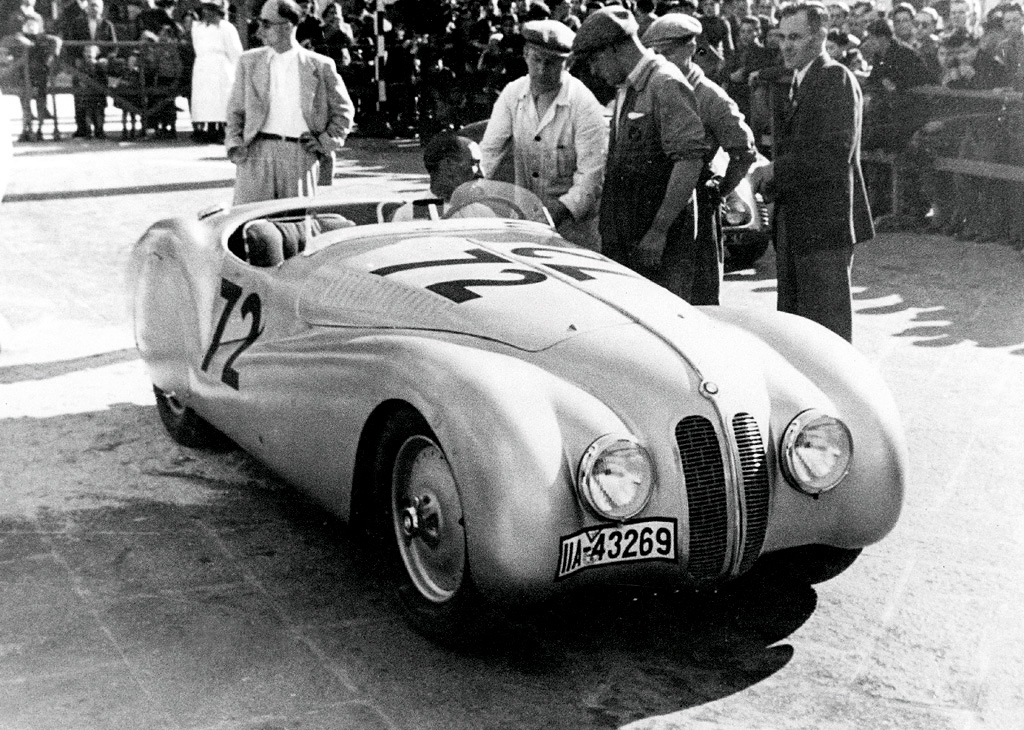
Photo of the real car. Photo: BMW Group PressClub / BMW AG