BMW V12 LMR was a sports racing prototype developed in 1999, the year BMW achieved one of the greatest victories in its motorsport history by winning the 24 Hours of Le Mans outright. Created in cooperation with engineers from Williams, the open-cockpit racing car combined a carbon-fibre monocoque, a powerful six-litre V12 engine and significantly improved aerodynamics. BMW entered two V12 LMRs in the 1999 Le Mans race. The car carrying number 17, driven by Tom Kristensen, JJ Lehto and Jörg Müller, led for most of the event before retiring following an accident caused by a mechanical failure. Overall victory eventually went to its sister car, number 15. Despite the retirement, BMW number 17 was one of the main protagonists of the race, having already won the 12 Hours of Sebring with the same drivers three months earlier.
BMW’s return to the highest level of Le Mans racing
BMW had already achieved considerable success in endurance racing before launching its own prototype programme. In 1995, a McLaren F1 GTR powered by a BMW V12 engine won the 24 Hours of Le Mans outright, demonstrating the competitiveness of BMW Motorsport’s engine technology in one of the world’s most demanding endurance races. Cooperation with McLaren continued over the following seasons, but BMW’s ambition was to develop a racing car carrying its own name. A technical partnership was therefore established with the British Williams Formula One team, resulting in the BMW V12 LM of 1998. Although the original prototype demonstrated promising speed, its Le Mans debut ended in disappointment when both factory-entered cars retired because of wheel-bearing problems. It became clear that extensive development was required for the following season. The resulting BMW V12 LMR retained the basic technical concept of its predecessor but was substantially redesigned in several important areas.
BMW, Williams and Schnitzer
Development of the BMW V12 LMR brought together three highly experienced motorsport organisations. BMW Motorsport was responsible for engine development and overall management of the racing programme, Williams engineers developed the chassis and aerodynamics, and Schnitzer Motorsport prepared and operated the cars at international racing events. On the Williams side, the project was directed by John Russell, whose task was to transform the previous year’s prototype into a faster and more reliable competition machine. Gerhard Berger and Mario Theissen played important roles in BMW’s motorsport management, while the racing team itself was led by the experienced Charly Lamm. Schnitzer had worked closely with BMW for decades, achieving success in touring-car and GT racing. The V12 LMR programme combined Williams’ Formula One engineering expertise, BMW’s sophisticated engine development and Schnitzer’s extensive endurance racing experience. This cooperation became one of the essential foundations of the team’s success in 1999.
From the V12 LM to the V12 LMR
The BMW V12 LMR was much more than a revised version of the 1998 racing car. Problems encountered during the original prototype’s debut encouraged the engineers to focus on mechanical simplicity, improved aerodynamic balance and long-term reliability. The new car received extensively modified front bodywork, more efficient aerodynamics and a simplified suspension system. One of the most visible changes was the single roll hoop positioned behind the driver, replacing the full-width structure used on the V12 LM. The lower, more streamlined body helped improve high-speed performance, while revised underbody airflow and a rear diffuser increased aerodynamic downforce. Ease of maintenance also became a major development priority, as a complicated repair could eliminate the advantage gained during hours of racing. The V12 LMR was therefore designed around the principle that an endurance racing car needed not only to achieve high speeds but also to maintain its performance reliably throughout an entire 24-hour race.
The 580 hp BMW S70/3 V12
The BMW V12 LMR was powered by a 5,990.5 cc naturally aspirated S70/3 V12 engine, developed from the BMW competition engine family originally used in the McLaren F1 GTR. Featuring a 60-degree cylinder-bank angle and aluminium-alloy construction, the engine employed four overhead camshafts and a total of 48 valves. Its bore measured 86 mm and its stroke 85.94 mm. According to BMW’s official technical documentation, the 1999 racing engine produced 580 hp at 6,500 rpm. Electronic fuel injection and dry-sump lubrication enabled the engine to combine substantial power with the reliability required for endurance racing. Its large capacity provided strong torque without the need for forced induction, while the smooth delivery of its twelve cylinders was particularly useful on long straights and when accelerating out of fast corners. Although quite different from the smaller turbocharged engines used by some competitors, BMW’s naturally aspirated V12 proved particularly well suited to the demanding conditions of Le Mans.
Carbon-fibre monocoque and racing chassis
The BMW V12 LMR was built around a carbon-fibre composite monocoque incorporating aluminium-honeycomb reinforcement. Its V12 engine was mounted longitudinally behind the driver and ahead of the rear axle, forming a compact drivetrain with the six-speed XTrac sequential racing gearbox. This layout provided favourable weight distribution and a low centre of gravity. Independent double-wishbone suspension was fitted at both ends, with inboard-mounted springs and dampers operated through pushrods and rocker mechanisms. Braking was provided by large carbon-based racing discs and six-piston calipers. The car used Michelin racing tyres, while BMW’s official specification listed a weight of 900 kg, corresponding to the minimum permitted in the prototype category. A specialist Le Mans archive gives a figure of 914 kg for the specific number 17 car, possibly reflecting its individual racing specification. The combination of low weight, powerful engine and sophisticated suspension allowed the V12 LMR to compete at the highest level of international prototype racing.
First victory – the 1999 12 Hours of Sebring
The BMW V12 LMR made its official competition debut on 20 March 1999 at the Sebring circuit in the United States. BMW entered two new prototypes in the 12-hour endurance race. The car carrying number 42 was shared by JJ Lehto, Tom Kristensen and Jörg Müller. It was chassis 002/99, the same car that would subsequently compete at Le Mans with number 17. BMW secured pole position during qualifying and demonstrated excellent speed throughout the race. During the final hours, a close battle developed between the BMW and a Riley & Scott prototype entered by Dyson Racing. After twelve hours of competition, the BMW crossed the finish line just 9.2 seconds ahead of its closest rival. The margin was among the smallest in Sebring’s history at that time and marked an exceptionally successful debut for the V12 LMR. The victory confirmed that the winter development programme undertaken by BMW and Williams had been effective and established the new prototype as a serious contender for overall victory at Le Mans.
The exceptionally competitive 1999 Le Mans
The 1999 24 Hours of Le Mans took place on 12–13 June and attracted one of the strongest fields of endurance racing cars of the decade. Major competitors included the BMW V12 LMR, Toyota GT-One, Mercedes-Benz CLR, Audi R8R, Audi R8C and Panoz LMP-1 Roadster S. Team BMW Motorsport entered two new V12 LMRs in the race, carrying numbers 15 and 17. The cars were supported by six experienced factory drivers and the Schnitzer team under Charly Lamm. BMW had already demonstrated the V12 LMR’s speed at Sebring, but Le Mans presented the much greater challenge of maintaining that performance over a complete 24-hour race. The Toyota GT-One proved an especially formidable rival, combining high-speed performance with sophisticated aerodynamic engineering. BMW relied on its powerful and reliable V12 engine, balanced chassis and the extensive endurance racing experience of its drivers and team personnel.
Car number 17 – three outstanding drivers
The BMW V12 LMR carrying racing number 17 was chassis V12LMR-002/99, driven by Denmark’s Tom Kristensen, Finland’s JJ Lehto and Germany’s Jörg Müller. Kristensen had won Le Mans on his debut in 1997 and would later become the most successful driver in the event’s history. Lehto was a former Formula One competitor who had already achieved overall victory at Le Mans in 1995 driving the BMW-powered McLaren F1 GTR. Müller was one of BMW’s key factory drivers, bringing experience from international single-seater championships and sports-car racing. The three drivers were already highly familiar with the V12 LMR, having won the 12 Hours of Sebring in the same chassis three months earlier. At Le Mans, car number 17 qualified third on the starting grid with a best lap time of 3 minutes and 31.209 seconds, making it the faster of BMW’s two entries in the race.
Leading Le Mans for more than 18 hours
BMW V12 LMR number 17 became one of the fastest and most successful cars in the 1999 Le Mans race. During the opening hours, Kristensen, Lehto and Müller moved into the leading group and soon established themselves at the front of the field. According to BMW’s historical account published in 2004, the car took the lead at 5:29 p.m. on Saturday, 12 June, and remained in front for more than 18 hours. Its sister BMW, number 15, frequently occupied second place, giving the team a substantial advantage over several major competitors. During the night and following morning, the two BMWs maintained a one-two position for approximately nine consecutive hours. Tom Kristensen later recalled that the number 17 car had built a lead of around three laps after 19 hours of racing. With the prototype performing reliably, the team’s attention began to shift towards preserving its advantage and reaching the finish without unnecessary risks.
A dramatic retirement at the Porsche Curves
Shortly before noon on Sunday, 13 June, with only a few hours remaining, BMW number 17 suffered one of the most dramatic accidents of the race. JJ Lehto was driving through the Porsche Curves when a mechanical failure caused the throttle linkage to jam. BMW’s official post-race statement explained that a suspension anti-roll-bar link had come loose and pressed against the throttle mechanism. Tom Kristensen later recalled that a damper-related component had moved against the anti-roll bar, causing the throttle linkage for one bank of the V12 engine to remain open. Lehto was unable to slow the car sufficiently and the BMW left the circuit at high speed, striking the barriers. Fortunately, the driver escaped without serious injuries, although the prototype sustained extensive damage. The car retired after completing 304 laps and approximately 4,136 kilometres. The Sebring-winning crew had lost the opportunity to claim a second major endurance racing victory just when overall success at Le Mans appeared to be within reach.
Car number 15 secures BMW’s historic victory
The retirement of car number 17 transformed the situation for Team BMW Motorsport, but the possibility of overall victory remained. The second BMW V12 LMR, carrying number 15, inherited the lead. This car, chassis 003/99, was driven by Pierluigi Martini, Yannick Dalmas and Joachim Winkelhock. During the closing stages, the BMW faced intense pressure from the Toyota GT-One shared by Ukyo Katayama, Keiichi Tsuchiya and Toshio Suzuki. The Toyota was able to challenge the BMW’s position but lost valuable time following a tyre failure late in the race. BMW number 15 retained the lead and crossed the finish line as the overall winner on 13 June 1999. It was BMW’s first outright Le Mans victory with a factory-entered racing car carrying its own name. The result was a historic achievement for the entire BMW motorsport programme, even though the crew of number 17 knew that their own car had been the strongest candidate for victory during much of the event.
Further victories for the same car in 2000
The racing career of BMW V12 LMR chassis 002/99 did not end with its accident at Le Mans in 1999. The car was repaired and returned to competition in the 2000 American Le Mans Series. In March, JJ Lehto and Jörg Müller finished third in the 12 Hours of Sebring in the same chassis. They then won the Charlotte race in April, followed by victory in the Silverstone 500 km event in Britain in May. A second-place finish followed at the Nürburgring 1000 km race in July, while the car achieved further podium results in North America. These performances demonstrated that the V12 LMR remained competitive during its second season, even as the new Audi R8 prototypes became increasingly dominant in international endurance racing. At the end of 2000, BMW concluded its factory V12 LMR programme, and chassis 002/99 subsequently became part of the BMW North America historical collection. The car has also appeared at historic motorsport events, including the 2016 Monterey Motorsports Reunion.
Only four V12 LMRs built
A total of four BMW V12 LMR chassis were constructed, carrying the designations 001/99, 002/99, 003/99 and 004/99. The first two examples competed in the 1999 12 Hours of Sebring, where chassis 002/99 achieved overall victory. Two additional cars were completed during the development programme for Le Mans, with chassis 002/99 and 003/99 selected for the main race. The remaining cars were used for testing and subsequent competition events. The V12 LMR was therefore an exceptionally limited-production racing machine rather than a competition version developed from an existing road car. All four chassis were constructed specifically for BMW and Williams’ endurance racing programme and were used during the 1999 and 2000 seasons. Their historical importance reflects both their rarity and their remarkable achievements, including overall victories at Le Mans and Sebring and multiple wins in the American Le Mans Series.
The legacy of the BMW V12 LMR
The BMW V12 LMR represents one of the most successful periods in BMW’s endurance racing history. Within a single winter, the technically troubled V12 LM of 1998 had evolved into a racing car capable of winning both the 12 Hours of Sebring and the 24 Hours of Le Mans. Its achievements were made possible through the combination of Williams’ advanced chassis and aerodynamic engineering, BMW’s powerful and reliable V12 engine, and Schnitzer’s expertise in endurance racing strategy. The car carrying number 17 has a particularly important place in this story. It won at Sebring, led Le Mans for more than 18 hours and returned to win further races during the following season. Although the ultimate Le Mans victory went to its sister car, number 15, the number 17 BMW played a central role in the team’s historic achievement. Today, the BMW V12 LMR remains one of the most significant racing cars in the manufacturer’s history, symbolising its ability to compete successfully at the highest level of international endurance racing.
Model in the collection
The BMW V12 LMR model in my collection was produced by Minichamps. It represents the Team BMW Motorsport prototype carrying racing number 17 at the 1999 24 Hours of Le Mans, driven by Tom Kristensen, JJ Lehto and Jörg Müller. The original car was chassis 002/99, which had already won the 12 Hours of Sebring with the same three drivers in March. At Le Mans, it led for most of the race before retiring after an accident caused by a mechanical failure. The model reproduces the V12 LMR’s low open-cockpit bodywork, distinctive roll hoop behind the driver, large rear wing and historic sponsorship markings.
Technical data
Year of construction: 1999
Body style: open sports racing prototype (Roadster)
Racing category: Le Mans Prototype (LMP)
Developed by: BMW Motorsport and Williams, Germany / United Kingdom
Racing team: Team BMW Motorsport, operated by Schnitzer Motorsport
Chassis construction: carbon-fibre and aluminium-honeycomb monocoque
Chassis number: V12LMR-002/99
Engine: BMW S70/3 naturally aspirated 60-degree V12
Displacement: 5,990.5 cc
Bore × stroke: 86 × 85.94 mm
Valve gear: four overhead camshafts, 48 valves
Fuel delivery: electronic fuel injection
Lubrication: dry sump
Power output: 580 hp at 6,500 rpm
Maximum torque: approximately 670 Nm
Engine position: longitudinally mid-mounted, ahead of the rear axle
Transmission: 6-speed XTrac sequential racing gearbox
Drive: rear-wheel drive
Suspension: independent double-wishbone racing suspension
Brakes: six-piston racing calipers with carbon-based discs
Tyres: Michelin
Weight: 900 kg according to BMW’s official specification; 914 kg reported for the specific Le Mans entry
Top speed: up to 342 km/h recorded in Le Mans event data
Production total: 4 cars
First race: 12 Hours of Sebring, 20 March 1999
Sebring result: overall victory, racing number 42
Le Mans race: 12–13 June 1999
Le Mans racing number: 17
Drivers: Tom Kristensen, JJ Lehto and Jörg Müller
Le Mans starting position: 3rd
Best qualifying lap: 3 min 31.209 sec
Laps completed at Le Mans: 304
Distance covered: approximately 4,136 km
Le Mans result: retired following an accident caused by a mechanical failure
Later achievements: victories at Charlotte and Silverstone in 2000
Special feature: Sebring-winning BMW V12 LMR that led the 1999 24 Hours of Le Mans for more than 18 hours before retiring because of a mechanical failure
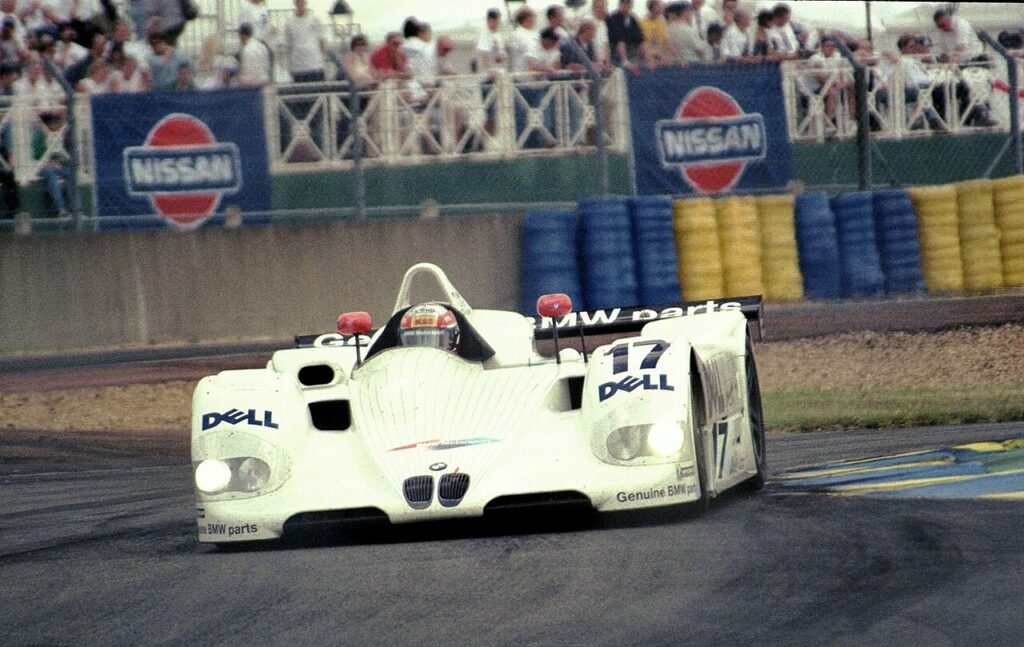
Photo of the real car. Photo: Martin Lee / Wikimedia Commons, CC BY-SA 2.0