
BMW M Hybrid V8 is BMW Motorsport’s LMDh hybrid racing prototype, marking the manufacturer’s return to the highest level of endurance racing after more than two decades. Developed in cooperation with Italian racing car constructor Dallara, the car combines a carbon-fibre monocoque, a four-litre twin-turbocharged V8 engine and an electric hybrid powertrain. The M Hybrid V8 was unveiled in 2022 and made its competition debut at the 2023 24 Hours of Daytona. Initially competing in North America’s IMSA championship, BMW expanded the programme to the FIA World Endurance Championship and the 24 Hours of Le Mans in 2024. Over the following seasons, the car developed into a competitive top-class prototype, achieving two World Endurance Championship race victories and second place overall at Le Mans in 2026. The BMW M Hybrid V8 therefore represents both the marque’s return to prototype racing and the arrival of hybrid technology among BMW’s most powerful competition cars.
BMW’s return to top-level prototype racing
BMW has a long history in international endurance racing, but one of its most important periods came during the late 1990s. Developed in cooperation with Williams engineers, the BMW V12 LM competed in the 1998 24 Hours of Le Mans, while its successor, the V12 LMR, achieved historic overall victory in 1999. BMW subsequently concentrated mainly on touring-car and GT racing programmes. A new opportunity to return to the highest category of prototype competition emerged with the development of the LMDh regulations, which allowed manufacturers to compete with the same type of racing car in both North America’s IMSA championship and the FIA World Endurance Championship. BMW confirmed its new programme in 2021 and established a technical partnership with Dallara. The M Hybrid V8 became BMW’s first new top-class endurance racing prototype since the V12 LMR era and marked a significant change in the manufacturer’s motorsport strategy.
LMDh – a new era in endurance racing
The BMW M Hybrid V8 was developed under the LMDh, or Le Mans Daytona hybrid, technical regulations. These were created through cooperation between the organisers of major international endurance racing championships, allowing manufacturers to use hybrid prototypes based on a common technical framework. LMDh cars are eligible for the GTP class of the IMSA WeatherTech SportsCar Championship and the Hypercar category of the FIA World Endurance Championship. Manufacturers can choose from four approved chassis constructors and develop their own bodywork and combustion engines, while the principal components of the electric hybrid powertrain are standardised. The objective was to control development costs and create competitive racing between different manufacturers. Performance is regulated through the Balance of Performance system, which controls factors including permitted power, weight and energy usage. This also allows LMDh prototypes to compete against Le Mans Hypercar, or LMH, cars developed under a different technical framework.
Dallara chassis and carbon-fibre construction
BMW selected Italian racing car specialist Dallara as its chassis development partner for the M Hybrid V8. Dallara brought extensive experience in single-seater racing cars, sports prototypes and carbon-fibre chassis manufacturing. The BMW was built around a Dallara-developed carbon-fibre composite monocoque, onto which BMW Motorsport integrated its aerodynamic bodywork and complete powertrain. The original LMDh regulations specified a wheelbase of 3,150 mm, with a maximum length of 5,100 mm and width of 2,000 mm. The minimum weight was set at 1,030 kg, although the actual permitted competition weight could vary under Balance of Performance regulations. The car’s mid-engine layout positioned the V8 behind the driver, forming a compact drivetrain together with the hybrid module and rear-mounted gearbox. The rear wheels remained the only driven wheels, as the electric hybrid motor also transmitted its power through the rear axle. The overall construction was designed to combine high structural rigidity, aerodynamic efficiency and the durability required for long-distance endurance racing.
Distinctive BMW design
The exterior design of the BMW M Hybrid V8 was developed jointly by BMW M Motorsport, BMW Group Designworks and Dallara. One of the design team’s most important objectives was to ensure that the low, wide racing prototype would be immediately recognisable as a BMW. Its most striking feature became the exceptionally wide kidney grille, integrated into the low nose and large aerodynamic air channels. The design also incorporated characteristic BMW lighting elements, a graphic reference to the Hofmeister kink in the side-window area, and details inspired by the mirrors of BMW M road cars. A closed cockpit occupied the central section of the bodywork, with a prominent longitudinal aerodynamic fin extending behind it. The rear diffuser and large wing were designed to generate substantial downforce while keeping aerodynamic drag under control. These features combined traditional BMW styling elements with the highly specialised bodywork of a modern endurance racing prototype.
Carbon-fibre bodywork and the presentation version
During the early development of the BMW M Hybrid V8, particular attention was given to the visual design and carbon-fibre construction of the prototype. On 6 June 2022, BMW announced the car’s name and initial appearance, introducing a distinctive camouflage design created by BMW Group Designworks. The camouflage contained references to historic BMW racing cars associated with North American motorsport, including the BMW 3.0 CSL, M1/C, 320i Turbo and BMW GTP. In September 2022, the official BMW M racing livery was unveiled in Los Angeles. Exposing the natural carbon-fibre surfaces of the bodywork also provided an effective way to emphasise the prototype’s technical construction and aerodynamic shape without conventional racing graphics. A carbon presentation version therefore differs from the numbered competition cars carrying their regular sponsorship markings. BMW also retained exposed carbon-fibre areas on its subsequent racing cars, helping reduce the additional weight associated with conventional paint and decorative coverings.
The DTM-derived P66/3 V8 engine
The combustion engine of the BMW M Hybrid V8 is the 3,999 cc twin-turbocharged P66/3 V8. Its origins can be traced to the naturally aspirated P66/1 engine used in the BMW M4 DTM during the 2017 and 2018 racing seasons. BMW Motorsport chose to develop this proven racing power unit rather than create an entirely new engine, which would have required significantly more time and resources. The first development stage produced the twin-turbocharged P66/2, focusing on power, durability and thermal management. This was followed by the final P66/3, adapted to the Dallara chassis and integrated with the electric hybrid drivetrain. The engine features a 90-degree cylinder-bank angle, an aluminium block and cylinder heads, four valves per cylinder and high-pressure direct fuel injection operating at 350 bar. According to BMW, the regulated engine output is approximately 640 hp, with maximum torque of around 650 Nm and an engine speed limit of 8,200 rpm. Lubrication is provided by a dry-sump system.
Hybrid powertrain and energy recovery
The BMW M Hybrid V8 combines its conventional combustion engine with the standardised LMDh hybrid system. The principal electric motor-generator and control components were developed by Bosch, the high-voltage battery by Williams Advanced Engineering and the seven-speed sequential gearbox by XTrac. The motor-generator is integrated into the drivetrain and can recover energy during braking, storing it for subsequent use during acceleration. The LMDh electric system has a specified continuous output of 50 kW, but the total permitted power of the hybrid racing car is limited by the applicable competition regulations. Consequently, the maximum outputs of the electric and combustion engines cannot simply be added together. The purpose of the hybrid system is to improve energy management and supplement the V8’s performance rather than provide four-wheel drive. BMW engineers also drew upon experience gained from the manufacturer’s earlier Formula E programme. Integrating the electric components into a compact and reliable competition drivetrain was one of the most demanding aspects of the entire development project.
The 2022 unveiling and initial testing
BMW officially revealed the name and initial appearance of the M Hybrid V8 on 6 June 2022, during the year in which BMW M celebrated its fiftieth anniversary. Initial testing of the complete hybrid powertrain took place during the summer, and on 25 July 2022 the prototype completed its first laps at Dallara’s test circuit in Varano de’ Melegari, Italy. Further testing followed at European circuits before the car was transported to North America in the autumn to prepare for the 2023 IMSA season. BMW M Motorsport worked closely with BMW M Team RLL to evaluate the reliability of the engine, hybrid drivetrain, cooling system and brakes. On 22 September 2022, BMW presented the official racing livery and driver line-up at the Petersen Automotive Museum in Los Angeles. The year 2022 was therefore a decisive development period, during which the project progressed from its initial presentation to a fully functioning competition prototype.
The 2023 racing debut and first victory
The BMW M Hybrid V8 made its official racing debut at the 24 Hours of Daytona on 28–29 January 2023. BMW M Team RLL entered two cars, carrying numbers 24 and 25, in the GTP category of the IMSA WeatherTech SportsCar Championship. The debut was not without technical problems, but both reliability and racing performance improved as the season progressed. The first major success came at the 6 Hours of Watkins Glen on 25 June 2023. BMW number 25, shared by Connor De Phillippi and Nick Yelloly, originally finished second on the road but was promoted to victory following a technical penalty for the first-placed Porsche. It was the M Hybrid V8’s first overall race victory and an important milestone in BMW’s return to prototype competition. Another historic achievement followed at Indianapolis Motor Speedway in September 2024, when BMW secured a one-two finish. The number 24 car driven by Philipp Eng and Jesse Krohn defeated the sister BMW carrying number 25.
The return to Le Mans in 2024
In 2024, the BMW M Hybrid V8 racing programme expanded to the FIA World Endurance Championship, commonly known as the WEC. The cars were prepared and operated by BMW M Team WRT, a Belgian racing organisation already successful with BMW GT competition cars. This marked BMW’s return to the highest level of Le Mans prototype racing 25 years after the V12 LMR’s historic overall victory in 1999. The M Hybrid V8 competed in the WEC Hypercar class against manufacturers including Toyota, Ferrari, Porsche and Cadillac. Its first season was challenging, but performance improved steadily as the team gained experience. In September 2024, BMW M Team WRT achieved the model’s first WEC podium finish at the 6 Hours of Fuji. At the same time, a separate IMSA programme continued in North America, allowing BMW to develop the prototype using experience gained from two highly competitive international championships.
Victories and the Le Mans podium in 2026
Continued development of the BMW M Hybrid V8 delivered major success in the FIA World Endurance Championship during 2026. On 9 May 2026, BMW M Team WRT achieved a one-two finish at the 6 Hours of Spa-Francorchamps, with the number 20 car driven by Robin Frijns, René Rast and Sheldon van der Linde defeating the sister BMW number 15. It was the model’s first overall WEC race victory. On 14 June 2026, the same three drivers finished second overall at the 24 Hours of Le Mans, just 10.9 seconds behind the winning Toyota. This was BMW’s first overall Le Mans podium finish since its victory in 1999. The number 15 BMW also achieved a historic pole position during qualifying. In July, a further WEC victory followed at the 6 Hours of São Paulo, where Kevin Magnussen, Raffaele Marciello and Dries Vanthoor won in BMW number 15. These achievements demonstrated that the M Hybrid V8 had developed into a serious contender for overall victories at the world’s most important endurance races.
The significance of the BMW M Hybrid V8
The BMW M Hybrid V8 represents an important milestone in BMW’s motorsport history, combining the tradition of earlier endurance racing prototypes with modern hybrid technology. Its development brought together BMW’s experience in DTM racing engines, electric drivetrains and international endurance competition. The partnership with Dallara made it possible to create a sophisticated carbon-fibre prototype whose appearance retained distinctive BMW design features. Following its 2022 unveiling and 2023 racing debut, the M Hybrid V8 gradually developed into a race-winning car, achieving success in both IMSA and the FIA World Endurance Championship. Its second-place finish at Le Mans in 2026 established an important historical connection with the BMW V12 LMR, which had secured overall victory in 1999. The M Hybrid V8 demonstrates how BMW’s established motorsport engineering expertise can be combined with new powertrain technologies to compete once again at the highest level of international endurance racing.
Model in the collection
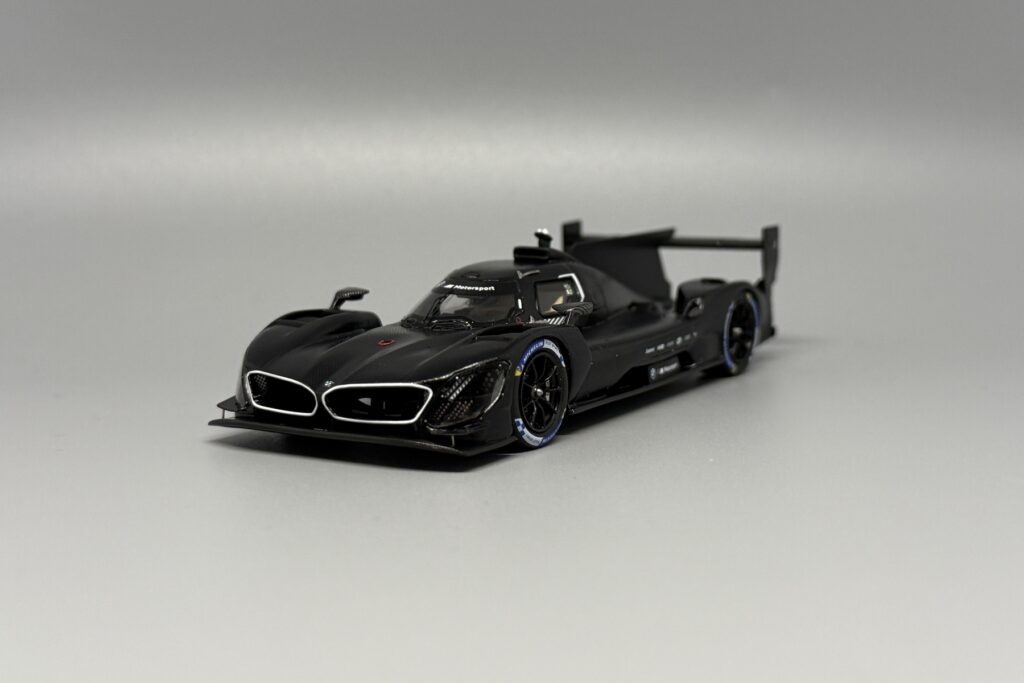
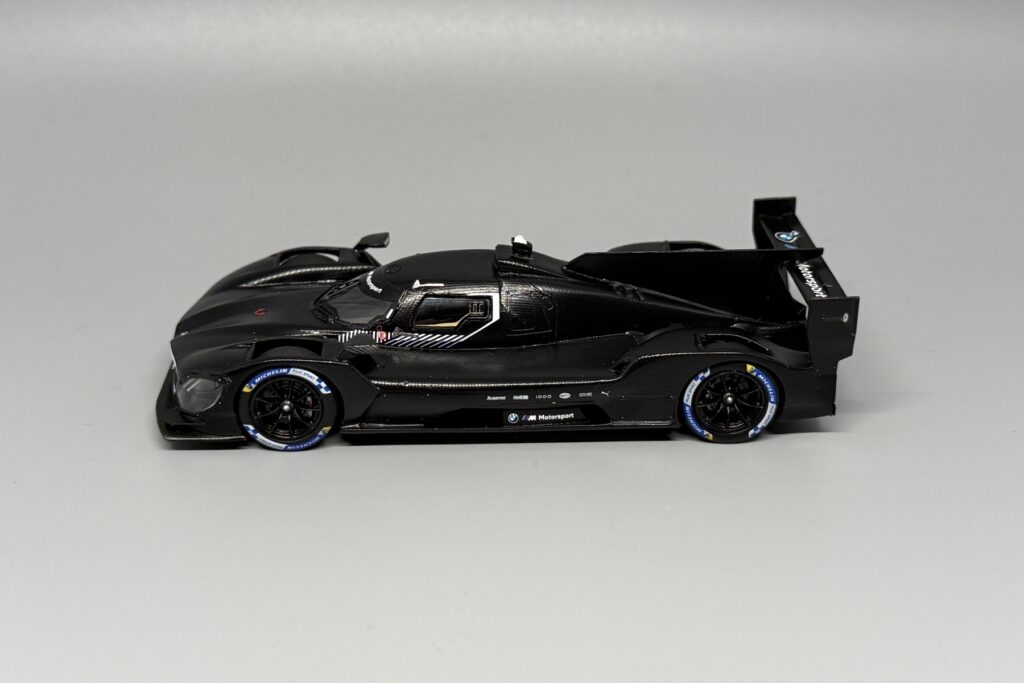
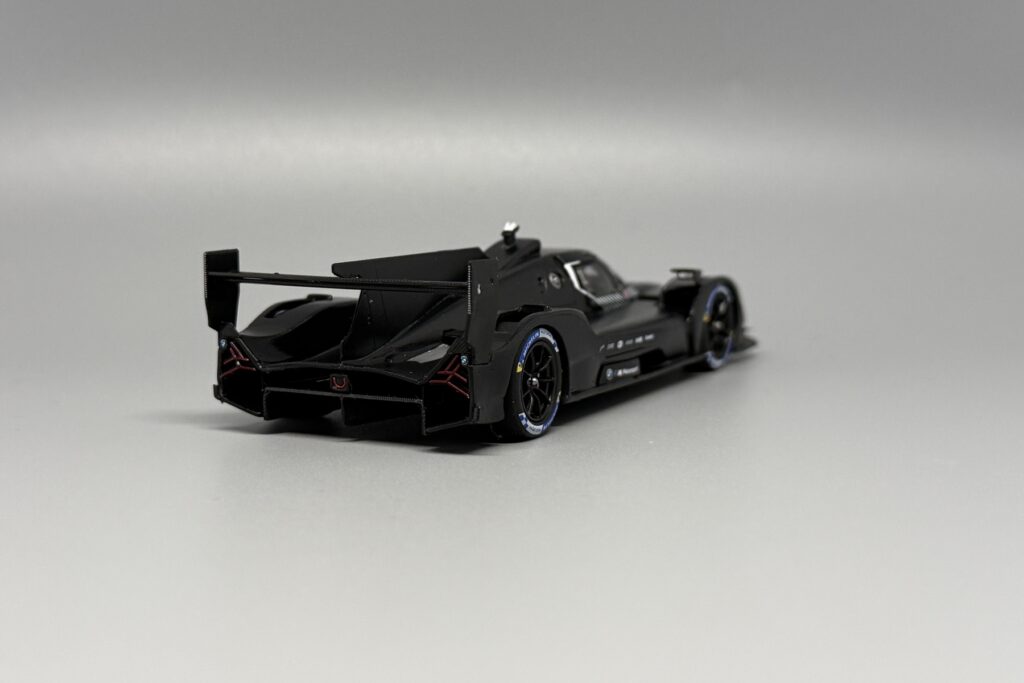
The BMW M Hybrid V8 Carbon model in my collection was produced by Spark. It represents the carbon-fibre presentation version of BMW’s LMDh prototype, associated with the car’s initial public introduction and development programme beginning in 2022. Unlike the later race entries, the model does not represent a specific numbered IMSA or Le Mans competition car. Instead, it highlights the original aerodynamic design and the distinctive technical appearance of the carbon-fibre bodywork. The model reproduces the M Hybrid V8’s low prototype silhouette, wide BMW kidney grille, enclosed cockpit, prominent longitudinal fin and large rear wing.
Technical data
First public unveiling: 6 June 2022
First track test: 25 July 2022, Varano de’ Melegari, Italy
Competition debut: 24 Hours of Daytona, 28–29 January 2023
Competition categories: LMDh; IMSA GTP and FIA WEC Hypercar
Developed by: BMW M Motorsport, Germany, and Dallara, Italy
Chassis: Dallara carbon-fibre composite monocoque
Body style: two-seat closed-cockpit endurance racing prototype
Engine: BMW P66/3 twin-turbocharged 90-degree V8
Displacement: 3,999 cc
Bore × stroke: 93 × 73.6 mm
Valve gear: four valves per cylinder
Fuel delivery: electronic high-pressure direct injection, 350 bar
Regulated combustion engine output: approximately 640 hp
Maximum torque: approximately 650 Nm
Maximum engine speed: 8,200 rpm
Lubrication: dry sump
Hybrid system: Bosch electric motor-generator and control system
Hybrid battery: Williams Advanced Engineering
Continuous electric motor output: 50 kW
Combined power: limited by competition-specific Balance of Performance regulations
Transmission: 7-speed XTrac sequential racing gearbox
Engine position: longitudinally mid-mounted, behind the driver
Drive: rear-wheel drive
Length: 5,100 mm
Width: 2,000 mm
Wheelbase: 3,150 mm
Weight: original LMDh minimum of 1,030 kg; competition weight subject to Balance of Performance adjustments
Racing teams: BMW M Team RLL (IMSA 2023–2025) and BMW M Team WRT (WEC from 2024; IMSA from 2026)
First overall victory: 6 Hours of Watkins Glen, 25 June 2023
First overall FIA WEC victory: 6 Hours of Spa-Francorchamps, 9 May 2026
Best Le Mans result to date: 2nd overall, 14 June 2026
Production total: exact number of competition chassis not publicly confirmed
Special feature: BMW’s first LMDh hybrid racing prototype, marking its return to top-level endurance racing and achieving second place overall at Le Mans in 2026
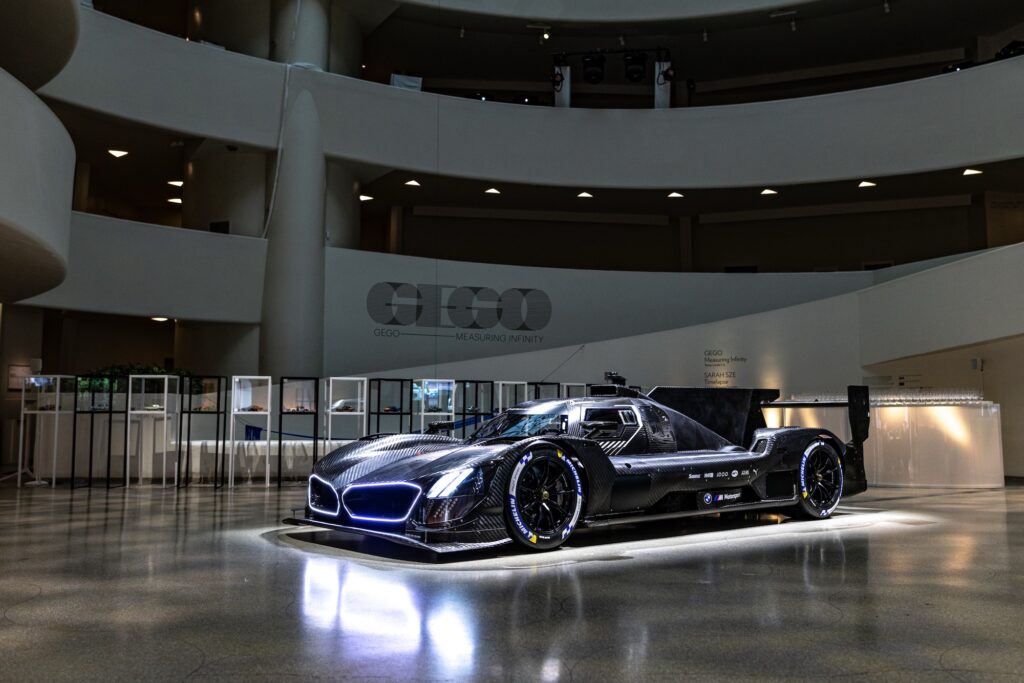
Photo of the real car. Photo: BMW AG / BMW Group Newsroom