BMW 6. seeria Coupé (E63) tähistas 6. seeria tagasitulekut BMW mudelivalikusse pärast pikka pausi. Varasem E24 põlvkond oli tootmises olnud kuni 1989. aastani ning alles 2000. aastate alguses tõi BMW suure luksusliku kupee uuesti valikusse. E63 põlvkond jõudis turule 2003. aastal ning sellest kujunes BMW kaasaegne tõlgendus klassikalisest grand tourer’ist: pikk mootorikate, madal kupeekere, võimsad mootorid ja luksuslik salong ühendasid pikamaasõidu mugavuse sportliku iseloomuga.
E63 põhines tehniliselt E60 5. seeria platvormil, kuid oli selgelt eksklusiivsema ja emotsionaalsema iseloomuga mudel. Kui 5. seeria oli eelkõige äriklassi sedaan, siis 6. seeria Coupé oli mõeldud ostjale, kes soovis suuremat individuaalsust, jõulisemat välimust ja elegantsemat kupeekerega autot. Samal ajal säilitas E63 BMW-le omase juhikeskse olemuse, tagaveolise arhitektuuri ja sportliku sõidutunnetuse.
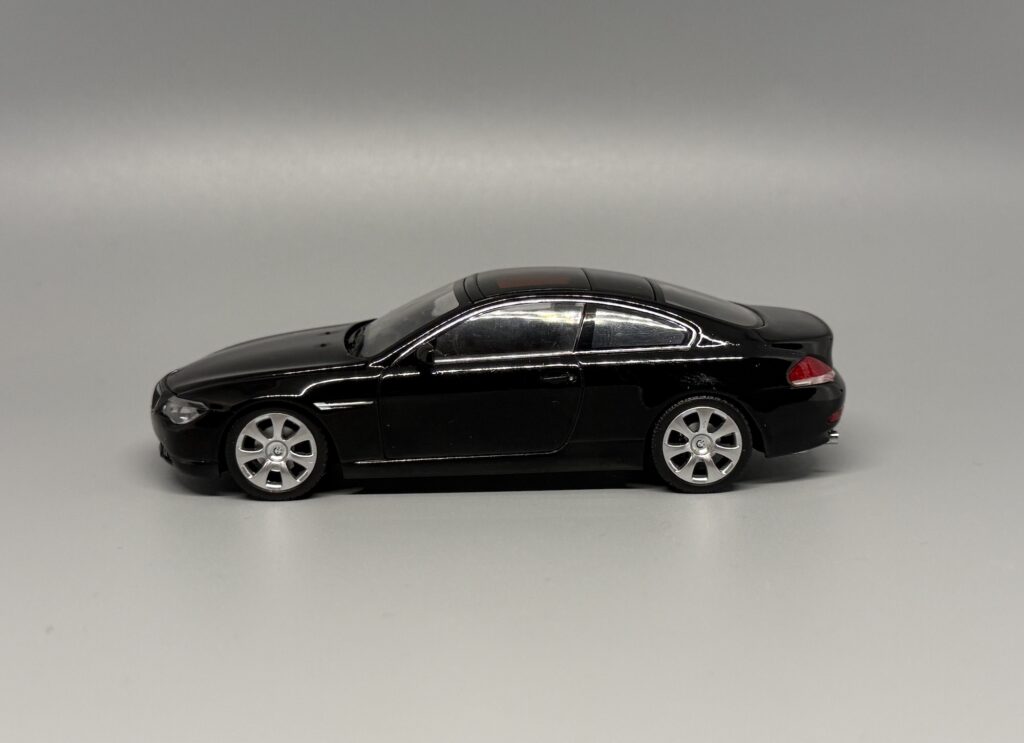
Disain oli E63 puhul üks kõige silmatorkavamaid omadusi. Mudel sündis BMW 2000. aastate alguse julge disainisuuna ajal, mida seostatakse Chris Bangle’i perioodiga. 6. seeria Coupé kuju oli pikk, madal ja voolujooneline, kuid samal ajal üsna jõuline ning omapärane. Eriti iseloomulikud olid pikalt venitatud mootorikate, lühike tagaosa, kõrge pagasiluugi joon ja tugevad kerepinnad. Esialgu tekitas selline disain palju arvamusi, kuid aja jooksul on E63 muutunud üheks äratuntavamaks 2000. aastate BMW kupeedest.
Salongis ühendas E63 luksusliku grand tourer’i mugavuse kaasaegse tehnoloogiaga. Auto pakkus neljakohalist paigutust, kvaliteetseid materjale, juhile suunatud armatuurlauda ja 2000. aastate BMW-le omast iDrive’i juhtimissüsteemi. Sõltuvalt versioonist ja varustusest sai E63-le tellida mitmeid mugavus- ja sõiduabilahendusi, mis sobisid hästi auto pikamaasõidule suunatud iseloomuga.
Mootorivalik oli lai ja kattis nii sportlikumaid kui ka pikamaasõidule suunatud versioone. Bensiinimootorite valik algas kuuesilindrilisest 630i-st, mis pakkus kergemat ja tasakaalukamat iseloomu. Mudelivaliku olulisemad V8-versioonid olid 645Ci ja hilisem 650i. 645Ci kasutas 4,4-liitrist V8 mootorit, samas kui 650i sai 4,8-liitrise V8 jõuallika võimsusega 367 hobujõudu. Hiljem lisandus valikusse ka 635d, mille 3,0-liitrine kahe turboga diiselmootor sobis eriti hästi suure kupee pikamaasõidu iseloomuga. Mudelipere tipus paiknes eraldi M-mudelina BMW M6 Coupé, mille vabalthingav 5,0-liitrine V10 mootor arendas 507 hobujõudu.
BMW 6. seeria Coupé (E63) tähtsus seisneb selles, et see tõi BMW suurte kupeede traditsiooni tagasi kaasaegsesse ajastusse. See ei olnud otsene E24 koopia, vaid täiesti uus ja 2000. aastatele omane tõlgendus BMW luksuslikust grand tourer’ist. E63 ühendas julgema disaini, kaasaegse tehnika, tugeva mootorivaliku ja pikamaasõiduks sobiva mugavuse viisil, mis eristas seda selgelt nii 5. seeriast kui ka väiksematest 3. seeria kupeedest.
Kokku toodeti E63 ja E64 põlvkonna 6. seeria mudeleid ilma M6 versioonideta 116 748 autot. Neist Coupé ehk E63 kerega autosid valmis 62 575. See teeb E63 Coupést piisavalt haruldase ja eristuva mudeli, kuid samas olulise osa BMW 2000. aastate mudelivalikust.
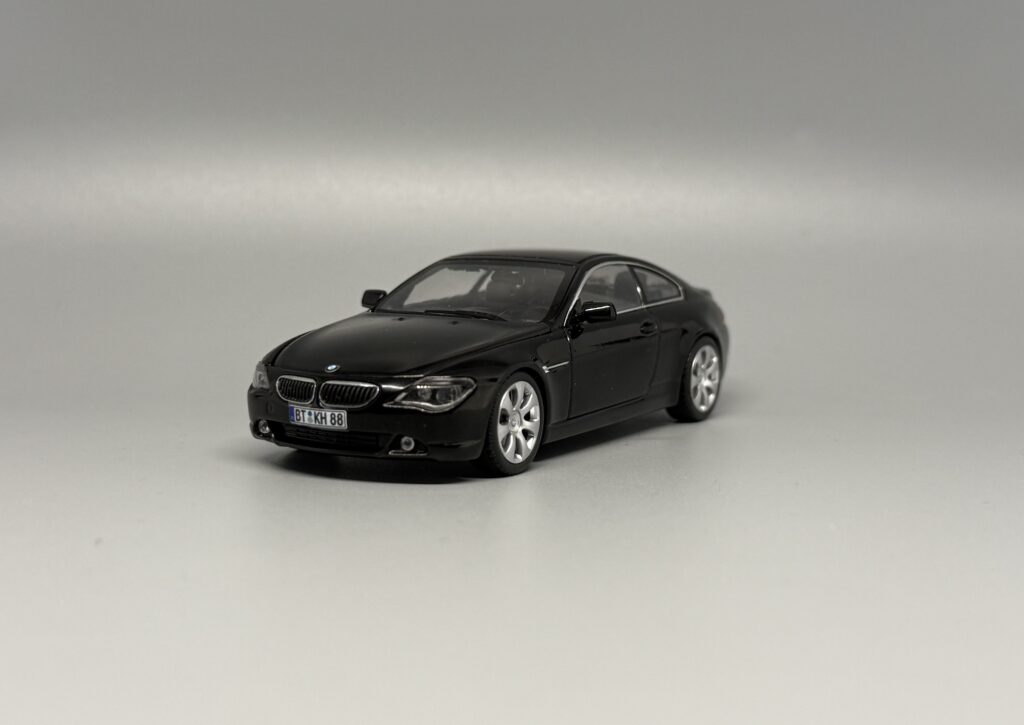
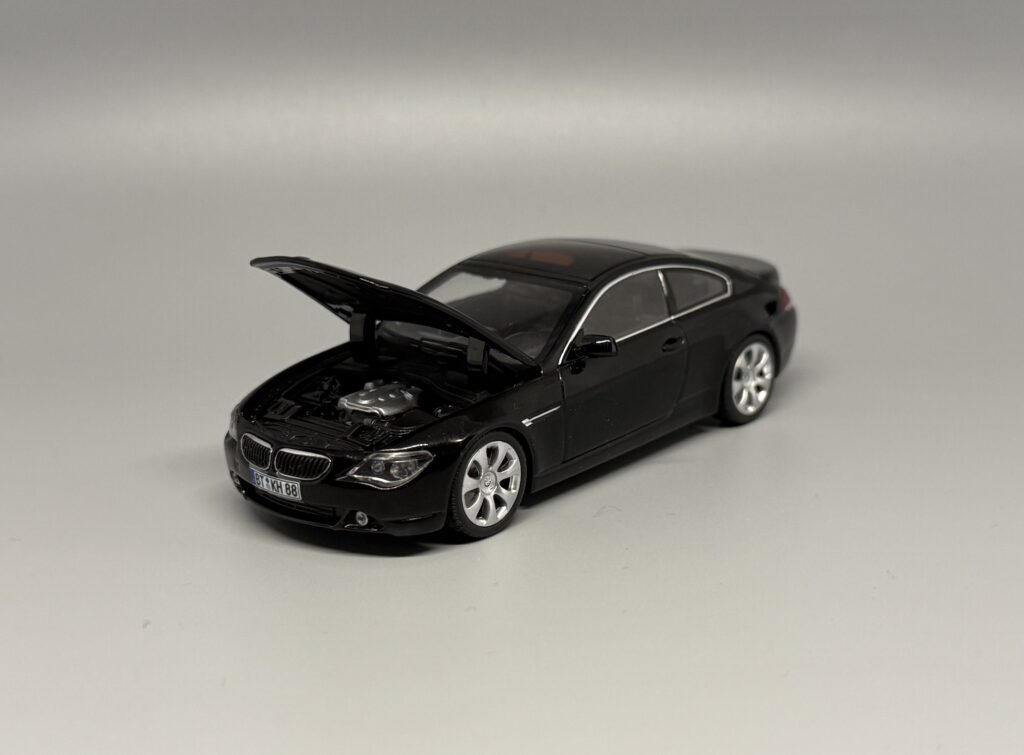
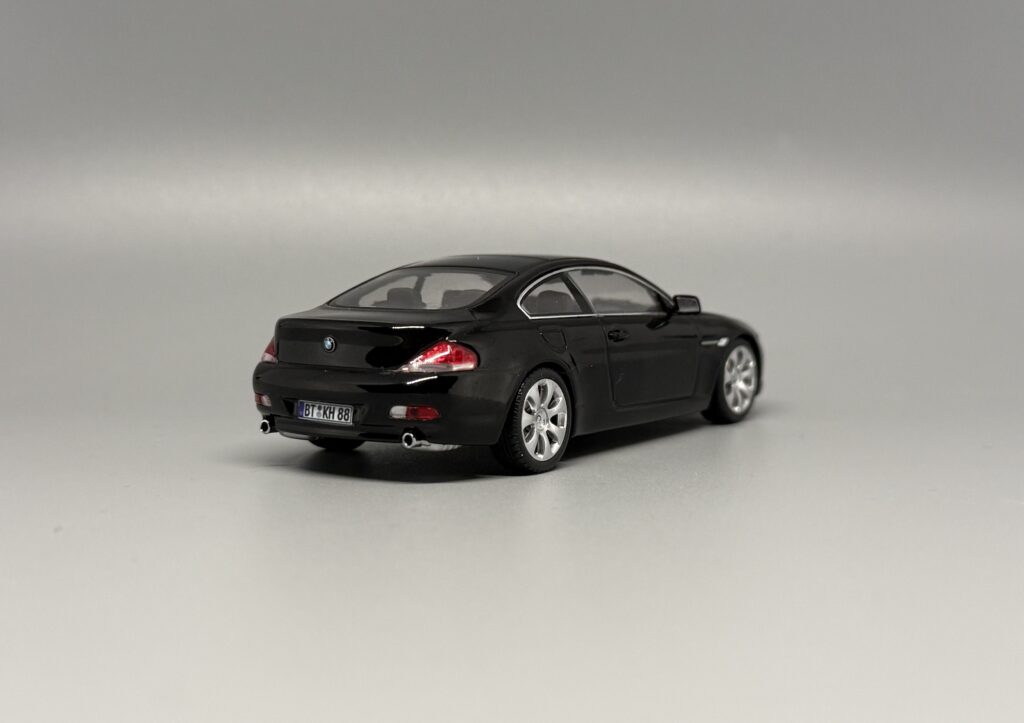
Minu kollektsioonis olev mudel on Minichampsi toodang. Mudel kujutab 2006. aasta BMW 6. seeria Coupé (E63) autot ning seda toodeti piiratud tiraažis kokku 1824 eksemplari.
Tehnilised andmed lühidalt:
Tootmisaeg: 2003–2010
Tootmiskoht: Dingolfing, Saksamaa
Keretüüp: kaheukseline grand tourer kupee
Mootorid: kuuesilindrilised ja V8 bensiini- ning kuuesilindriline diiselmootor
Võimsus: tavaversioonides sõltuvalt mudelist kuni 367 hj 650i puhul
M6 Coupé: eraldi M-mudel 5,0 l V10 mootoriga ja 507 hj
Käigukast: manuaal-, automaat- või SMG-käigukast sõltuvalt versioonist
Veoskeem: tagavedu
Tootmisarv: 62 575 E63 Coupé autot
Eripära: 6. seeria tagasitulek pärast E24 põlvkonda ning BMW luksusliku grand tourer’i kaasaegne tõlgendus
BMW 6 Series Coupé (E63) marked the return of the 6 Series to the BMW model range after a long absence. The earlier E24 generation had remained in production until 1989, and only in the early 2000s did BMW bring a large luxury coupé back into its line-up. The E63 generation was launched in 2003 and became BMW’s modern interpretation of the classic grand tourer: a long bonnet, low coupé body, powerful engines and a luxurious interior combined long-distance comfort with a sporting character.
The E63 was technically based on the E60 5 Series platform, but it had a clearly more exclusive and emotional character. While the 5 Series was primarily an executive saloon, the 6 Series Coupé was aimed at buyers who wanted greater individuality, a stronger visual presence and a more elegant coupé body. At the same time, the E63 retained BMW’s driver-focused nature, rear-wheel-drive architecture and sporty driving feel.
Design was one of the most striking aspects of the E63. The model was created during BMW’s bold early-2000s design period, associated with the Chris Bangle era. The shape of the 6 Series Coupé was long, low and flowing, but also powerful and distinctive. Especially characteristic were the stretched bonnet, short rear section, high boot-lid line and strong body surfaces. At first, this design generated many opinions, but over time the E63 has become one of the most recognisable BMW coupés of the 2000s.
Inside, the E63 combined the comfort of a luxury grand tourer with modern technology. The car offered a four-seat layout, high-quality materials, a driver-oriented dashboard and BMW’s iDrive control system typical of the 2000s. Depending on version and equipment, the E63 could be ordered with a wide range of comfort and driver-assistance features, well suited to the car’s long-distance character.
The engine range was broad and covered both sportier and more long-distance-focused versions. The petrol line-up began with the six-cylinder 630i, which offered a lighter and more balanced character. The most important V8 versions were the 645Ci and the later 650i. The 645Ci used a 4.4-litre V8 engine, while the 650i received a 4.8-litre V8 producing 367 hp. Later, the 635d was added to the range, with a 3.0-litre twin-turbo diesel engine that suited the large coupé’s long-distance character particularly well. At the top of the model family stood the separate M model, the BMW M6 Coupé, whose naturally aspirated 5.0-litre V10 engine produced 507 hp.
The significance of the BMW 6 Series Coupé (E63) lies in the way it brought BMW’s tradition of large coupés back into the modern era. It was not a direct copy of the E24, but a completely new interpretation of BMW’s luxury grand tourer for the 2000s. The E63 combined bold design, modern technology, a strong engine range and long-distance comfort in a way that clearly distinguished it from both the 5 Series and the smaller 3 Series coupés.
In total, 116,748 E63 and E64-generation 6 Series models were produced without the M6 versions. Of these, 62,575 were Coupé-bodied E63 cars. This makes the E63 Coupé a relatively distinctive model, while still an important part of BMW’s 2000s model range.
The model in my collection is produced by Minichamps. The model represents a 2006 BMW 6 Series Coupé (E63) and was produced in a limited run of 1824 pieces.
Technical data in brief:
Production period: 2003–2010
Production location: Dingolfing, Germany
Body style: two-door grand tourer coupé
Engines: six-cylinder and V8 petrol engines, and a six-cylinder diesel engine
Power: up to 367 hp in regular versions, depending on model, for the 650i
M6 Coupé: separate M model with a 5.0-litre V10 engine and 507 hp
Transmission: manual, automatic or SMG transmission depending on version
Drivetrain: rear-wheel drive
Production number: 62,575 E63 Coupé cars
Special feature: return of the 6 Series after the E24 generation and a modern interpretation of BMW’s luxury grand tourer

BMW 6. seeria Coupé (E63) tähistas 6. seeria tagasitulekut BMW mudelivalikusse pärast pikka pausi. Varasem E24 põlvkond oli tootmises olnud kuni 1989. aastani ning alles 2000. aastate alguses tõi BMW suure luksusliku kupee uuesti valikusse. E63 põlvkond jõudis turule 2003. aastal ning sellest kujunes BMW kaasaegne tõlgendus klassikalisest grand tourer’ist: pikk mootorikate, madal kupeekere, võimsad mootorid ja luksuslik salong ühendasid pikamaasõidu mugavuse sportliku iseloomuga.
E63 põhines tehniliselt E60 5. seeria platvormil, kuid oli selgelt eksklusiivsema ja emotsionaalsema iseloomuga mudel. Kui 5. seeria oli eelkõige äriklassi sedaan, siis 6. seeria Coupé oli mõeldud ostjale, kes soovis suuremat individuaalsust, jõulisemat välimust ja elegantsemat kupeekerega autot. Samal ajal säilitas E63 BMW-le omase juhikeskse olemuse, tagaveolise arhitektuuri ja sportliku sõidutunnetuse.
Disain oli E63 puhul üks kõige silmatorkavamaid omadusi. Mudel sündis BMW 2000. aastate alguse julge disainisuuna ajal, mida seostatakse Chris Bangle’i perioodiga. 6. seeria Coupé kuju oli pikk, madal ja voolujooneline, kuid samal ajal üsna jõuline ning omapärane. Eriti iseloomulikud olid pikalt venitatud mootorikate, lühike tagaosa, kõrge pagasiluugi joon ja tugevad kerepinnad. Esialgu tekitas selline disain palju arvamusi, kuid aja jooksul on E63 muutunud üheks äratuntavamaks 2000. aastate BMW kupeedest.
Salongis ühendas E63 luksusliku grand tourer’i mugavuse kaasaegse tehnoloogiaga. Auto pakkus neljakohalist paigutust, kvaliteetseid materjale, juhile suunatud armatuurlauda ja 2000. aastate BMW-le omast iDrive’i juhtimissüsteemi. Sõltuvalt versioonist ja varustusest sai E63-le tellida mitmeid mugavus- ja sõiduabilahendusi, mis sobisid hästi auto pikamaasõidule suunatud iseloomuga.
Mootorivalik oli lai ja kattis nii sportlikumaid kui ka pikamaasõidule suunatud versioone. Bensiinimootorite valik algas kuuesilindrilisest 630i-st, mis pakkus kergemat ja tasakaalukamat iseloomu. Mudelivaliku olulisemad V8-versioonid olid 645Ci ja hilisem 650i. 645Ci kasutas 4,4-liitrist V8 mootorit, samas kui 650i sai 4,8-liitrise V8 jõuallika võimsusega 367 hobujõudu. Hiljem lisandus valikusse ka 635d, mille 3,0-liitrine kahe turboga diiselmootor sobis eriti hästi suure kupee pikamaasõidu iseloomuga. Mudelipere tipus paiknes eraldi M-mudelina BMW M6 Coupé, mille vabalthingav 5,0-liitrine V10 mootor arendas 507 hobujõudu.
BMW 6. seeria Coupé (E63) tähtsus seisneb selles, et see tõi BMW suurte kupeede traditsiooni tagasi kaasaegsesse ajastusse. See ei olnud otsene E24 koopia, vaid täiesti uus ja 2000. aastatele omane tõlgendus BMW luksuslikust grand tourer’ist. E63 ühendas julgema disaini, kaasaegse tehnika, tugeva mootorivaliku ja pikamaasõiduks sobiva mugavuse viisil, mis eristas seda selgelt nii 5. seeriast kui ka väiksematest 3. seeria kupeedest.
Kokku toodeti E63 ja E64 põlvkonna 6. seeria mudeleid ilma M6 versioonideta 116 748 autot. Neist Coupé ehk E63 kerega autosid valmis 62 575. See teeb E63 Coupést piisavalt haruldase ja eristuva mudeli, kuid samas olulise osa BMW 2000. aastate mudelivalikust.
Minu kollektsioonis olev mudel on Minichampsi toodang. Mudel kujutab 2006. aasta BMW 6. seeria Coupé (E63) autot ning seda toodeti piiratud tiraažis kokku 1824 eksemplari.
Tehnilised andmed lühidalt:
Tootmisaeg: 2003–2010
Tootmiskoht: Dingolfing, Saksamaa
Keretüüp: kaheukseline grand tourer kupee
Mootorid: kuuesilindrilised ja V8 bensiini- ning kuuesilindriline diiselmootor
Võimsus: tavaversioonides sõltuvalt mudelist kuni 367 hj 650i puhul
M6 Coupé: eraldi M-mudel 5,0 l V10 mootoriga ja 507 hj
Käigukast: manuaal-, automaat- või SMG-käigukast sõltuvalt versioonist
Veoskeem: tagavedu
Tootmisarv: 62 575 E63 Coupé autot
Eripära: 6. seeria tagasitulek pärast E24 põlvkonda ning BMW luksusliku grand tourer’i kaasaegne tõlgendus
BMW 6 Series Coupé (E63) marked the return of the 6 Series to the BMW model range after a long absence. The earlier E24 generation had remained in production until 1989, and only in the early 2000s did BMW bring a large luxury coupé back into its line-up. The E63 generation was launched in 2003 and became BMW’s modern interpretation of the classic grand tourer: a long bonnet, low coupé body, powerful engines and a luxurious interior combined long-distance comfort with a sporting character.
The E63 was technically based on the E60 5 Series platform, but it had a clearly more exclusive and emotional character. While the 5 Series was primarily an executive saloon, the 6 Series Coupé was aimed at buyers who wanted greater individuality, a stronger visual presence and a more elegant coupé body. At the same time, the E63 retained BMW’s driver-focused nature, rear-wheel-drive architecture and sporty driving feel.
Design was one of the most striking aspects of the E63. The model was created during BMW’s bold early-2000s design period, associated with the Chris Bangle era. The shape of the 6 Series Coupé was long, low and flowing, but also powerful and distinctive. Especially characteristic were the stretched bonnet, short rear section, high boot-lid line and strong body surfaces. At first, this design generated many opinions, but over time the E63 has become one of the most recognisable BMW coupés of the 2000s.
Inside, the E63 combined the comfort of a luxury grand tourer with modern technology. The car offered a four-seat layout, high-quality materials, a driver-oriented dashboard and BMW’s iDrive control system typical of the 2000s. Depending on version and equipment, the E63 could be ordered with a wide range of comfort and driver-assistance features, well suited to the car’s long-distance character.
The engine range was broad and covered both sportier and more long-distance-focused versions. The petrol line-up began with the six-cylinder 630i, which offered a lighter and more balanced character. The most important V8 versions were the 645Ci and the later 650i. The 645Ci used a 4.4-litre V8 engine, while the 650i received a 4.8-litre V8 producing 367 hp. Later, the 635d was added to the range, with a 3.0-litre twin-turbo diesel engine that suited the large coupé’s long-distance character particularly well. At the top of the model family stood the separate M model, the BMW M6 Coupé, whose naturally aspirated 5.0-litre V10 engine produced 507 hp.
The significance of the BMW 6 Series Coupé (E63) lies in the way it brought BMW’s tradition of large coupés back into the modern era. It was not a direct copy of the E24, but a completely new interpretation of BMW’s luxury grand tourer for the 2000s. The E63 combined bold design, modern technology, a strong engine range and long-distance comfort in a way that clearly distinguished it from both the 5 Series and the smaller 3 Series coupés.
In total, 116,748 E63 and E64-generation 6 Series models were produced without the M6 versions. Of these, 62,575 were Coupé-bodied E63 cars. This makes the E63 Coupé a relatively distinctive model, while still an important part of BMW’s 2000s model range.
The model in my collection is produced by Minichamps. The model represents a 2006 BMW 6 Series Coupé (E63) and was produced in a limited run of 1824 pieces.
Technical data in brief:
Production period: 2003–2010
Production location: Dingolfing, Germany
Body style: two-door grand tourer coupé
Engines: six-cylinder and V8 petrol engines, and a six-cylinder diesel engine
Power: up to 367 hp in regular versions, depending on model, for the 650i
M6 Coupé: separate M model with a 5.0-litre V10 engine and 507 hp
Transmission: manual, automatic or SMG transmission depending on version
Drivetrain: rear-wheel drive
Production number: 62,575 E63 Coupé cars
Special feature: return of the 6 Series after the E24 generation and a modern interpretation of BMW’s luxury grand tourer
Foto päris autost. Algne allikas teadmata
Photo of the real car. Original source unknown