Tagasi BMW 3 Series-le
BMW M3 (E30)
In this section
BMW 3 Series
BMW 3 Series Sedan (E21)
BMW 323i (E21)
BMW 316 Cabriolet Prototyp Karmann (E21)
BMW 320 Baur TopCabriolet (E21)
BMW 320i Gr.2 (E21)
BMW 320i (E30)
BMW 325i (E30)
BMW 320i Touring (E30)
BMW 320i Cabriolet (E30)
BMW M3 (E30)
BMW M3 cabrio (E30)
BMW M3 Sport Evolution (E30)
BMW 318i Baur TC2 (E30)
BMW 3 Series Sedan (E36)
BMW 318is/4 Class II (E36)
BMW 3 Series Coupe (E36)
BMW 328i Touring (E36)
BMW 3 Series Cabrio (E36)
BMW 3 Series Compact (E36/5)
BMW M3 Coupe (E36)
BMW M3 Coupe (E36)
BMW M3 GTR Street (E36)
BMW 3 Series Sedan (E46)
BMW 318i (E46)
BMW 328 CI Coupe (E46)
BMW 318i Touring (E46)
BMW 328 Touring (E46)
BMW 323 Cabrio (E46)
BMW 325ti Compact (E46/5)
BMW M3 Coupe (E46)
BMW M3 Cabrio (E46)
BMW M3 GTR Street (E46)
BMW M3 GTR Street (E46)
BMW 320i Streetversion (E46/4)
BMW 3 Series Sedan (E90)
BMW 3 Series Touring (E91)
BMW 3 Series Coupe (E92)
BMW 3 Series Convertible (E93)
BMW M3 Coupe (E92)
BMW M3 GTS (E92)
BMW M3 GT2 Street (E92)
BMW M3 Convertible (E93)
BMW 335i Sedan (F30)
BMW 3 Series Touring (F31)
BMW 3 Series Gran Turismo (F34)
BMW M3 (G80)
BMW M3 M-Perfomance (G80)
BMW M3 CS (G80)
BMW AC Schnitzer M3 Competition (G80)
BMW M3 M-Performance Touring (G81)
BMW M3 (E30) on üks BMW ajaloo legendaarsemaid sportmudeleid ning auto, mis pani aluse kogu M3 mudelirea mainele. Mudel loodi homologatsioonieesmärgil, et võimaldada BMW-l osaleda rahvusvahelises turismiautode võidusõidus. Esimest korda jõudis M3 tootmisse 1986. aastal ning see eristus tavalisest E30 3. seeriast oluliselt laiema kere, muudetud aerodünaamika, teistsuguste keredetailide ja selgelt sportlikuma üldilme poolest. See oli auto, mis tõi võidusõidust lähtunud tehnika tänavale ning kujunes kiiresti üheks oma ajastu olulisemaks sportkupeeks.
E30 M3 ei olnud lihtsalt võimsama mootoriga 3. seeria. Selle kere oli põhjalikult ümber kujundatud: laiendatud rattakoopad, muudetud tagaklaasi nurk, kõrgem tagaluuk, esispoiler ja tagatiib teenisid aerodünaamika ning võistlusliku kasutuse eesmärki. Just selline sihipärane arendus tegi E30 M3-st väga erilise homologatsioonimudeli. BMW ise on nimetanud E30 M3 üheks edukaimaks turismiautoks, mis kunagi toodetud, ning mudeli võistluskarjäär aitas oluliselt tugevdada BMW Motorsporti mainet.
Tehniliselt kasutas BMW M3 E30 neljasilindrilist S14B23 ridamootorit töömahuga 2302 cm³. Alguses arendas mootor ilma katalüsaatorita 200 hobujõudu, kuid Saksamaa turule mõeldud katalüsaatoriga versioonis oli võimsus 195 hobujõudu. 1989. aasta septembris tõsteti katalüsaatoriga versiooni võimsus 215 hobujõuni. Kuigi mootor oli vaid neljasilindriline, oli see kerge, kõrgetel pööretel elav ja otseselt motorspordist mõjutatud jõuallikas, mis sobis väga hästi M3 täpse ja vahetu iseloomuga.
Tootmisperioodi jooksul arendati BMW M3 E30 pidevalt edasi ning mudelile lisandus mitmeid eriversioone. Peaaegu igal tootmisaastal toimusid väiksemad või suuremad tehnilised muudatused, mis aitasid hoida mudeli võistlusvõimelisena ja huvitavana ka tänavaautona. Sportlik varustus, väga hea juhitavus ja soodne võimsuse-kaalu suhe tegid E30 M3-st auto, mida hindasid nii võidusõitjad kui ka entusiastid.
BMW M3 E30 tähtsus seisneb selles, et see lõi M3 mudelirea põhiolemuse: kompaktne kere, motorspordist lähtuv tehnika, täpne juhitavus ja juhile suunatud iseloom. Tänapäeval peetakse E30 M3-e üheks kõige puhtamaks M-autoks ning kogu BMW M ajaloo üheks tähtsaimaks mudeliks. See ei ole ainult esimene M3, vaid ka auto, mille edu rajal ja maanteel muutis M3 nime legendiks.
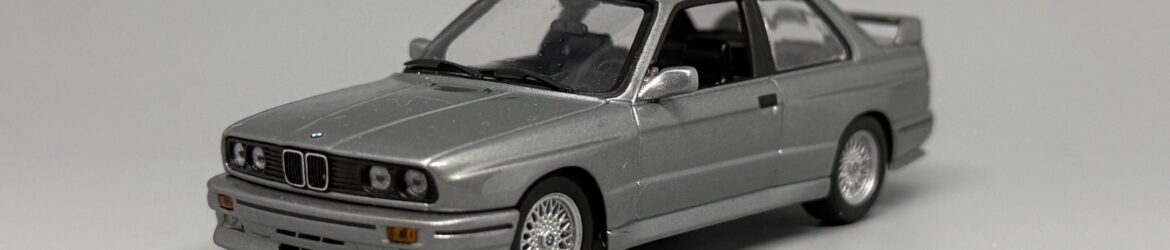
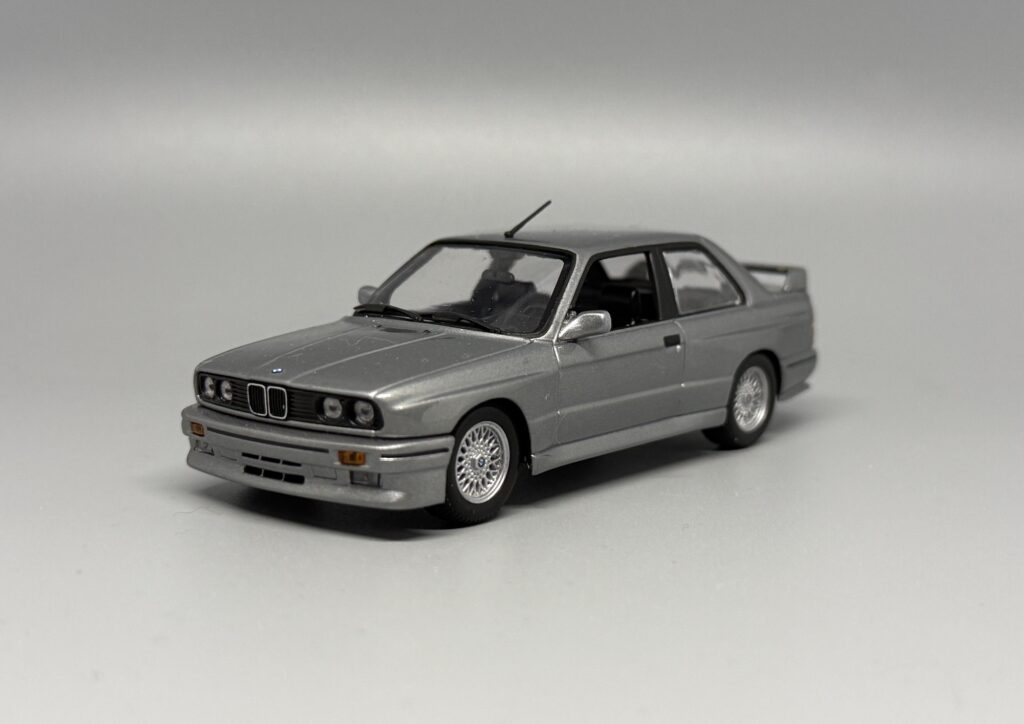
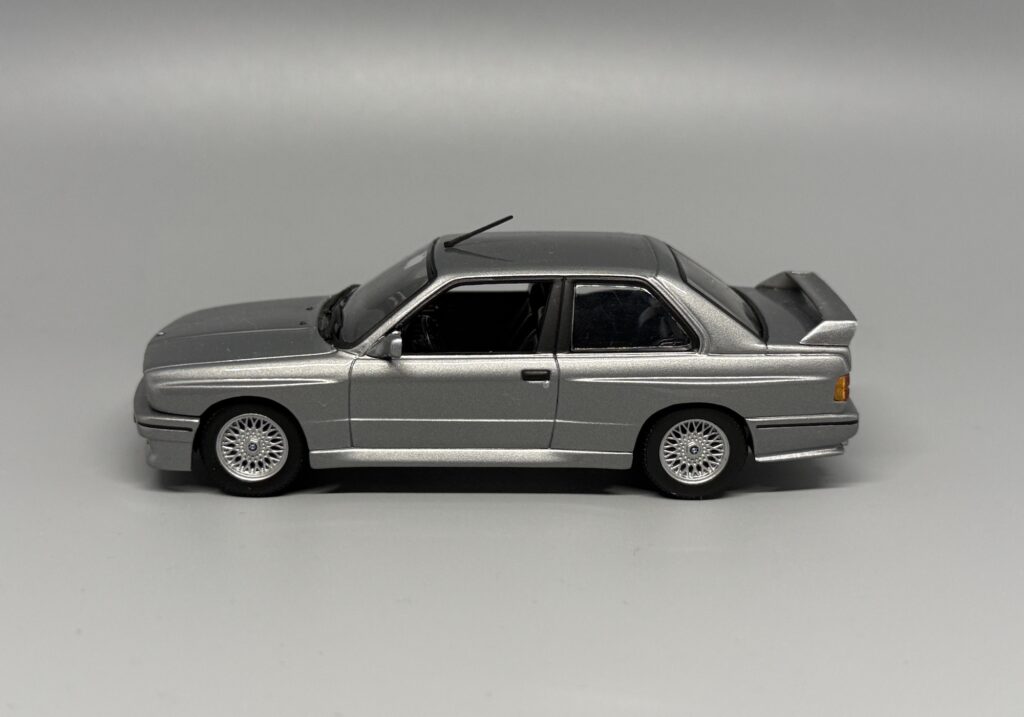
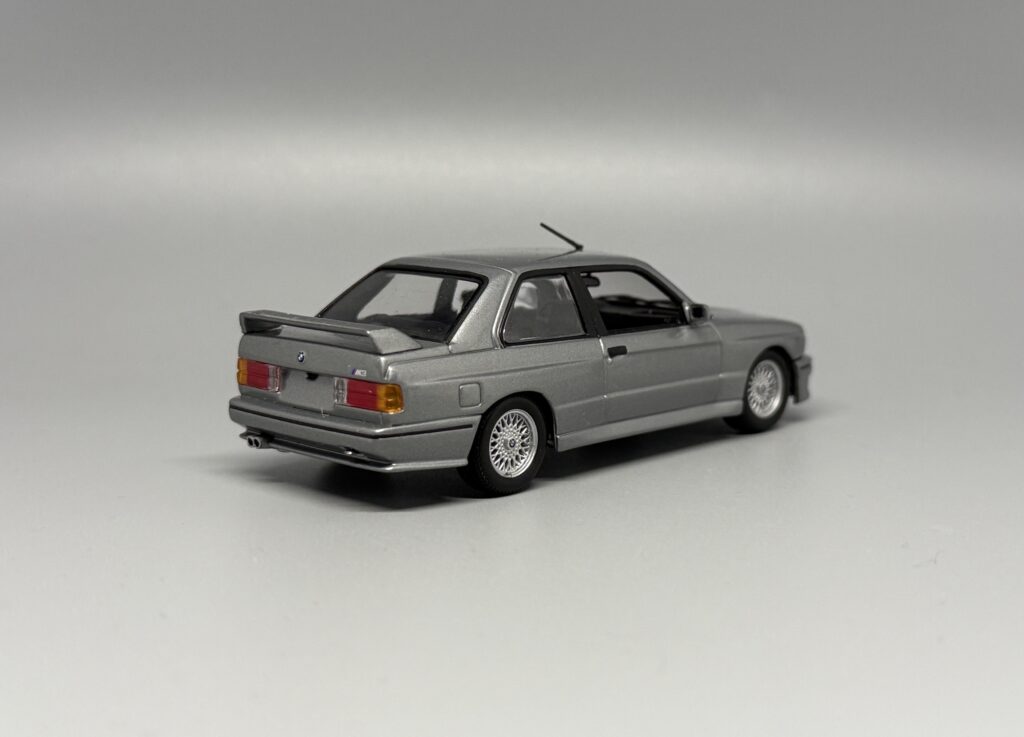
Minu kollektsioonis olev mudel on Minichampsi toodang. Tegemist on piiratud tiraažiga mudeliga, mida toodeti 3888 eksemplari. Mudel kujutab 1987. aasta autot.
Tehnilised andmed lühidalt:
Tootmisaeg: 09/1986–12/1990
Tootmiskoht: Saksamaa
Keretüüp: kaheukseline sportkupee
Mootor: 2,3 l neljasilindriline ridamootor S14B23
Töömaht: 2302 cm³
Võimsus: 195 hj katalüsaatoriga, 200 hj ilma katalüsaatorita, alates 09/1989 kuni 215 hj
Käigukast: 5-käiguline manuaal
Veoskeem: tagavedu
Tippkiirus: 230 km/h
Tootmisarv: üle 17 000 auto
Mudelauto tootmisarv: 3888 eksemplari
Eripära: homologatsioonimudel ja esimene BMW M3, millest kujunes üks BMW ajaloo edukamaid ning kuulsamaid sportkupeesid
BMW M3 (E30) is one of the most legendary sports models in BMW history and the car that established the reputation of the entire M3 model line. The model was created for homologation purposes, allowing BMW to compete in international touring car racing. The M3 entered production in 1986 and differed significantly from the regular E30 3 Series through its wider body, revised aerodynamics, different body panels and clearly more sporting overall appearance. It was a car that brought racing-derived technology to the road and quickly became one of the most important sports coupés of its era.
The E30 M3 was not simply a 3 Series with a more powerful engine. Its body was extensively redesigned: widened wheel arches, a revised rear window angle, a higher boot lid, a front spoiler and a rear wing all served aerodynamic and competition-related purposes. This focused development made the E30 M3 a very special homologation model. BMW has described the E30 M3 as one of the most successful touring cars ever produced, and the model’s racing career played an important role in strengthening the reputation of BMW Motorsport.
Technically, the BMW M3 E30 used the four-cylinder S14B23 in-line engine with a displacement of 2302 cc. Initially, the engine produced 200 hp without a catalytic converter, while the catalytic-converter version for the German market produced 195 hp. In September 1989, the output of the catalytic-converter version was increased to 215 hp. Although the engine had only four cylinders, it was light, lively at high revs and strongly influenced by motorsport, making it a perfect match for the precise and direct character of the M3.
During its production run, the BMW M3 E30 was developed continuously and several special versions were added to the range. Almost every production year brought smaller or larger technical changes, helping the model remain competitive in racing and interesting as a road car. Sporty equipment, excellent handling and a favourable power-to-weight ratio made the E30 M3 highly appreciated by both racing drivers and enthusiasts.
The importance of the BMW M3 E30 lies in the way it created the core identity of the M3 model line: a compact body, motorsport-derived technology, precise handling and a driver-focused character. Today, the E30 M3 is regarded as one of the purest M cars and one of the most important models in BMW M history. It is not only the first M3, but also the car whose success on the track and on the road turned the M3 name into a legend.
The model in my collection is produced by Minichamps. It is a limited-edition model, with 3888 pieces produced. The model represents a 1987 car.
Technical data in brief:
Production period: 09/1986–12/1990
Production location: Germany
Body style: two-door sports coupé
Engine: 2.3-litre S14B23 four-cylinder in-line engine
Displacement: 2302 cc
Power: 195 hp with catalytic converter, 200 hp without catalytic converter, up to 215 hp from 09/1989
Transmission: 5-speed manual
Drivetrain: rear-wheel drive
Top speed: 230 km/h
Production number: over 17,000 cars
Model car production number: 3888 pieces
Special feature: homologation model and the first BMW M3, which became one of the most successful and famous sports coupés in BMW history
Foto päris autost. Foto: Sten-Patrick Kreek
Photo of the real car. Photo: Sten-Patrick Kreek